Why Sacramentals are Important in the Spiritual Life

Why are you praying to a false god or making the rosary an idol? I believe in going to the top guy (God) right away…why mess around?

Whether you are a cradle Catholic or a recent convert you’ve likely heard similar accusations against the usage of material objects in prayer. It is true that Jesus is the one true mediator to God the Father. If you choose to only pray to Jesus your petitions, thanks, praises, and laments will be listened to by God.

Yet, a close reading of the Bible, especially the miracle stories in the Gospel and an examination of Sacred Tradition will reveal how sacred objects act as a bridge (and not a wedge) to God.

According to the Catechism of the Catholic Church paragraph 1668,

Sacramentals are instituted for the sanctification of certain ministries of the Church, certain states of life, a great variety of circumstances in Christian life, and the use of many things helpful to man. In accordance with bishops’ pastoral decisions, they can also respond to the needs, culture, and special history of the Christian people of a particular region or time. They always include a prayer, often accompanied by a specific sign, such as the laying on of hands, the sign of the cross, or the sprinkling of holy water (which recalls Baptism).

Difference between a Sacrament and a Sacramental

Sacraments and Sacramentals

Sacraments are visible signs of God’s invisible grace. Put another way, “The sacraments are efficacious signs of grace, instituted by Christ and entrusted to the Church, by which divine life is dispensed to us” (CCC 1131).

Sacramentals are sacred signs instituted by the Church and help the faithful prepare for the sacraments.

To put it a bit more simply: Christ instituted the sacraments and the Catholic Church instituted the sacramentals. Jesus gave bestowed authority to the Apostles (foremost in Peter and the office of the papacy but also in the communion of bishops) to bind and loose. Although the official seven sacraments are the foundation of Catholic life, sacramentals aren’t unimportant as they help to draw a person closer in to the sacramental life.

Sacramentals

Sacramentals act as a bridge (not a wedge) between humanity and God.

Evidence in the Bible for Sacramentals

Now that we established the distinction between the sacraments and sacraments let’s examine some biblical evidence for the latter.

Genesis tells us of how God created the world. One important thing to note about the first creation account is how God viewed the material world as good. Even before the Incarnation, God becoming man in the person of Jesus Christ, there is an inherent goodness to the created world.

God didn’t intend for humanity to be saved in an ethereal or ghostly manner. There’s a concreteness, a tangibility, to the central event of Christianity: The Resurrection. Jesus really did rise bodily from the dead. On of the more commonly overlooked tenets of the Nicene Creed is the belief in the bodily resurrection at the end of time. Because of this teaching it makes perfect sense for the sacramental life to be tangible too.

God’s plan of salvation become revealed over the course of several centuries. Hints (or foreshadowings) of the sacraments and sacramentals are mentioned in the Bible.

Here’s a few examples of “sacramentals” in the Bible:

  • 2 Kings5:10— Elisha commanded the Naaman to wash in the Jordan River seven times to cure him of leprosy
  • 2 Kings 13:20-21—man who was buried came back to life upon touching the bones of Elisha
  • Luke 8:44— woman suffering from hemorrhages healed when she touched Jesus’ cloak
  • John9:6-12— Jesus cured the blind man using mud

More direct references to sacramentals include:

  • Numbers 5:17— “In an earthen vessel [the priest] shall take holy water, as well as some dust from the floor of the tabernacle and put it in the water.”
  • 2 Kings 2:19-22— Elisha restores the impure water of a well with holy salt
  • Luke 9:23 and Gal 6:14— refer to the importance of the sign of the cross

Evidence in Sacred Tradition for Sacramentals

Saint Francis of Assisi is one of the most well known and beloved of all Catholic saints. He had a love of God and creation. Francis taught about the importance of the Incarnation in his word and deeds. In the Canticle of Creation, Francis praised God by reflecting on the beauty of created things. He refers to the Sun as Brother and the Moon as Sister. His prayer continued the long Catholic tradition of seeing the goodness of creation. Matter is not something inherently evil by rather good.

The Incarnation

In the Mystery of the Incarnation Jesus bridges the gap between God and humanity.

Sacramentals point to the Incarnation: items or words (blessings) endowed with spiritual significance. Matter and spirit are united not divided. Just like how in the Mystery of the Incarnation God become fully man while remaining fully God.

Over the centuries Catholic saints have spoken about the significance of sacramentals. Saint Remigius of Auxerre spoke of the importance of holy salt, “It should be known, that in the Old Testament no sacrifice was offered to God unless it were first sprinkled with salt, for none can present an acceptable sacrifice to God without the flavour of heavenly wisdom.” Doctor of the Church Saint Louis de Montfort wrote this about the Rosary, “For never will anyone who says his Rosary every day become a formal heretic or be led astray by the devil. This is a statement which I would sign with my blood.” Bold statement. But true!

Sacramentals Help Increase Devotion

Sacramentals aren’t talisman or objects that magically get a person to Heaven. According to the Baltimore Catechsim Q. 1052, “A sacramental is anything set apart or blessed by the Church to excite good thoughts and to increase devotion, and through these movements of the heart to remit venial sin.” Both Sacred Scripture and Sacred Tradition contain reference and usage of sacred objects for excite devotion. Holy salt, holy water, blessings, and the sign of the Cross are just a few examples. In the upcoming weeks, we will be examining the history and importance of specific sacramentals.


P.S. Welcome to the post-article credits (Hey Marvel movies have done it for years why can’t a blogger do the same?? 😀)

If you enjoyed learning about sacramentals and want to read similar content become an email subscriber. Enter your email address in the Subscribe to Blog Via Email box and hit the Subscribe button. It’s that easy! Soon you will be receiving cool, inspiring, and orthodox Catholic content in your inbox.
Thank you for sharing!

Join Together—the Message of Jolly Pope John XXIII


Editor’s Note: Post originally published on October 15, 2018.


According to the Nicene Creed, the first of the distinguishing marks of the Catholic Church is unity. Without unity things tend to fall apart: societies collapse, families fight, and friendships evaporate. Over the course of history the Church has undergone a multitudes of developments and faced its share of difficulties threatening union. Jesus Christ promised that in spite of the conflicts unity still would persist through the office of the papacy.

United by the Holy Spirit

Guided by the power of the Holy Spirit all successors to the original “rock” of the Church, the Apostle St. Peter, provide stability and direction to the faithful. While I have been blessed with to live witness the tail end of the prominent papacy of St. John Paul II [the Great], I recently made an effort to acquaint myself with former pontiffs from the 20th century. Most recently, I learned more about the wondrous, albeit brief, papacy of the St. John XXIII.

Two words immediately come to mind with I think of John XXIII—jolliness and unity! He was a joyfully jolly individual whose papacy promoted greater unity for all mankind.  The Italian pope declared, “The whole world is my family.”

While at face value, this appears to be a simple and unimpressive statement, looking at the human conflicts currently existing in the world today and throughout history, we suddenly realize that disunity is part and parcel of human nature. Opening the world to the Catholic Church via the initiation of the Second Vatican Council, John XXIII opened the supernatural ark and invited humanity a chance assess the spiritual graces housed in the Catholic Church.

I am grateful to have discovered the positivity, and harmonious message of the pope of the Second Vatican Council. Below are several insightful and uplifting words from St. John XXII we can reflect on for the rest of the week!

Selected Quotes

“I want to throw open the windows of the Church so that we can see out and the people can see in.”

“Before everything else, fidelity to the Church: One, Holy, Catholic, and Apostolic. Jesus did not found several churches, but one single Church.”

“O Jesus in the Blessed Sacrament, I would like to be filled with love for You; keep me closely united with You, may my heart be near to Yours. I want to be to You like the apostle John. O Mary of the Rosary, keep me recollected when I say these prayers of yours; bind me forever, with your rosary, to Jesus of the Blessed Sacrament. Blessed be Jesus, my love.”

“Men are like wine – some turn to vinegar, but the best improve with age.”

Thank you for sharing!

Catholic Meme Monday— Issue 52

Hope you had a blessed weekend!  

Time for another Catholic Meme Monday.

🎵🎶All you need is love 🎶🎵
Looks about right. 😆😀🤦
😆😆😆
😆😆
Never too early for a Saint Nick meme. 😆🙂🥊
You will never unsee it. 😆🙂
🙂😆😆
Noah’s ark memes are the best. 🙂⛵🛳️
A belated Saint Francis day meme. ♥️🙂
Can’t help sharing another pun. 🙂

That’s all I have this week. Stay tuned for next week’s Catholic Meme Monday. Receive updates straight to your email inbox by subscribing to The Simple Catholic blog.

Thank you for sharing!

Faustina’s Faith: How A Simple Polish Nun Changed My World


Editor’s Note: Post originally published on October 10, 2017.


October 5th marked the Feast Day of St. Maria Faustina Kowalska. Venerated by the Catholic Church as the “Apostle of Mercy” the Polish saint influenced the world arguably more than any other individual in the 20th century. I have mentioned this previously and I will mention this again, Sister Faustina holds a special place in my heart. She has impacted my writing and spirituality as much as anyone. Classified as a mystic because of her unique spiritual experiences and visions from God, Maria Faustina is a model of what holiness looks like when an individual completely trusts on the Father’s will. As a belated celebration of her Feast Day, I will reflect on a couple ways the Polish nun influenced my life.

maria faustina


Daily Dose of Divine Mercy

Maria Faustina received this message from our Lord during her visions,

“‘I am love and Mercy Itself.  There is no misery that could be a match for My mercy, neither will misery exhaust it, because as it is being granted – it increases.  The soul that trusts in My mercy is most fortunate, because I Myself take care of it.’” (1273, page 459).

In His infinite wisdom, God reminded the world—through the young Polish sister—that His mercy overcomes anything. The 20th century experienced two world wars and many decades of Communism. St. Faustina died of tuberculosis before the advent of WWII. God used her as an instrument to prepare people that hope will not be lost despite the atrocities of the Holocaust.

On a personal level, my family has been transformed spiritually by God’s mercy. The Chaplet of Divine Mercy Prayer pulled my wife from the depths of despair after her close high school friend died by suicide. Faustina’s intercession within my wife’s life poured into my spiritual life as well. Frequently, I look to God’s mercy in times of trial and desolation in daily living. I am grateful for St. Maria Faustina’s “YES” to God’s divine plan.

dr who


Trust Me I’m the Doctor

I need to be direly ill before I allow myself to go to the doctor. Unfortunately, sometimes the same can be said about my spiritual life. Because of my stubbornness and pride, I only seek help from the divine physician when I need spiritual triage. I need to develop a better trust is Jesus Christ—my divine healer—to aid me both in desperate times and during daily living! According to St. Faustina, trust is an essential feature in growing in the spiritual life. Here is an excerpt from her diary:

Today the Lord said to me, ‘Daughter, when you go to confession, to this fountain of My mercy, the Blood and Water which came forth from My Heart always flows down upon your soul and ennobles it.  Every time you go to confession, immerse yourself entirely in My mercy, with great trust, so that I may pour the bounty of My grace upon your soul.  When you approach the confessional, know this, that I Myself am waiting there for you.  I am only hidden by the priest, but I Myself act in your soul.  Here the misery of the soul meets the God of Mercy.  Tell souls that from this fount of mercy souls draw graces solely with the vessel of trust.  If their trust is great, there is no limit to My generosity.  The torrent of grace inundate humble souls.  The proud remain always in poverty and misery, because My grace turns away from them to humble souls. (1602, page 568)

confessional.jpg


Do I trust that God is present in the confessional? Am I aware that I am spiritually infirmed and in need of healing? Jesus tells us, “Those who are well do not need a physician, but the sick do” (Luke 5:31). Through the intercession of Sister Maria I have learned to view Jesus more as a divine doctor and the Catholic Church as a hospital.  Let us ask for healing from our sin and weakness by asking Christ the Divine Physician for restorative union with God:

Healing Novena

To Christ the Great Physician
We know that there is one physician:
Both flesh and spirit
uncreated, yet born
God in man
True life in death
From both Mary and From God
Subject to suffering and then impassible
Jesus Christ our Lord!

We ask O Great Physician, for spiritual, physical, and emotional healing, especially my intention of ______.
You of both flesh and spirit

May we spend all of our days in your healing presence
You the eternal Son born for us

Grant us the healing benefits of your Incarnation, Death, and Resurrection
You who are true God and true man

Grant us your true life in the midst of death
You, the true life in death

Grant us to follow your example and that of your Blessed Mother
You, from both Mary and from God

May our suffering be for our growth; free us, we pray, from that which we cannot bear
We ask You, O God the Word who became man to suffer

We ask you to grant us this healing if it brings us closer to you,
Jesus Christ our Lord!

bear prayer


Related Links

3 Ways St. Maria Faustina Provided Buoyancy in the Overwhelming Ocean of Life

Saint Maria Faustina Kowalska The Humble Instrument

St. Faustina’s Eucharistic Wisdom: 10 Gems

3 Reasons Why I Am Thankful for Divine Mercy Sunday!


Thank you for sharing!

Catholic Meme Monday— Issue 51

Hope you had a blessed weekend!  

Time for another Catholic Meme Monday.

Looks about right. 😆😆😆
😀🙂😆
Have pride in yourself but don’t succumb to too much pride. Lol
One of the funniest and an edifying yo mama joke! 😆
This kept me laughing and laughing. 😆😆😆
Mercy over mathematics.
He branched out. 🌳🙂🪜
😆😆😆
A punny Old Testament meme for you. 😆🙂😀

That’s all I have this week. Stay tuned for next week’s Catholic Meme Monday. Receive updates straight to your email inbox by subscribing to The Simple Catholic blog.

Thank you for sharing!

How Tetherball is Like the Catholic Church

best game ever


Editor’s Note: This post was originally published on May 1, 2015.


I will begin today’s post by comparing the structure of the Catholic Church to a somewhat “elementary” thing. Let me give you some word clues. Hopscotch. Foursquare. Kickball. Red Rover. Before I confuse you anymore please let me briefly explain the context to why I am talking about children’s playground games and religion in the same paragraph.

During this past year I worked at a Catholic high school and taught Old and New Testament. On the day we discussed the epic first century saints Peter and Paul, I gave my students a simple analogy. A healthy Catholic Church is likened to a game of tetherball. To better help you understand what I mean precisely with that example please let us first discuss why Peter and Paul are important to Christianity.

Stability of the Rock

Matthew 16:16-19 has Peter clearly stating the identity of Jesus Christ and thereafter he is entrusted with the “keys to the kingdom of Heaven”. Catholics interpret this passage as hard and fast proof for the papacy. To cite Fr. Robert Barron in his book Catholicism [referring to Peter’s special insight], “And this knowledge did not come from Peter’s native intelligence or from an extraordinary education…It came as a gift from God, a special charism of the Holy Spirit.” (p. 121). Thus, God chose a pope from the very beginning to be that stability upon we, as Catholics, can rely on. If the Church had multiple heads its teachings would devolve into something ugly–like the multi-head monster in Greek myth– the hydra. In a similar way, the center-post in a tetherball game provides stability for the game to happen.

Creativity of a Theologian

creativity

Now let’s turn our attention to St. Paul. While the popes enjoy the office of St. Peter and provide stability to the Catholic Church, having this Petrine element alone would make Her teachings dry and rocky. Thus, to balance out the papacy there is a need for theology to make the Church healthy.

 After Paul’s conversion in Acts 9 until the end of the book, the saint is literally always on the move. As I told my students, “Paul does not have biblical ADD, but rather he was the spark of life that started the early Christian churches”. Citing from Fr. Barron again, “Paul stands for mission, the engagement of the culture and proclamation. Every missionary, teacher, preacher, and theologian, is, in this sense, a son or daughter of Paul.” (p. 141). Paul represents an archetype within the Catholic Church to adapt to different times and cultures. He represents the spunk that enlivens the Church. Going back to the tetherball analogy the rope and ball provide the excitement for the playground game.

always on the move

Structure + Flexibility= Healthy Church

A healthy Church needs both structure (papacy) and flexibility (theology). So too does a tetherball game needs the center-post= [representing the papacy/Petrine element] and the rope and ball= [representing theology/Pauline element]. 
 
The schoolyard game would be pointless if a center-post did not exist to keep the ball close for the players to bat around. At the same time a game consisting of only a metal pole would be stagnant and boring. Similarly, the Catholic Church without the dynamic element St. Paul brought in the first century and whose memory represents today.
tetherball

Which playground game is God’s favorite? I would imagine that God has all the time in the world to try them all and find them equally enjoyable, but if I had to venture a guess I would pick tetherball! 🙂

Thank you for sharing!

An Unexpected Journey- How September 21st, 2017 Became the New Start to My Spiritual Life

hobbit gif.gif


Editor’s Notes: Originally published September 22nd, 2017


Over the past few weeks, life has been throwing stress-filled curveballs at me. Reeling from anxiety, anger, and frustration, I recently went to the spiritual medicine box—Confession—to gain sacramental graces to help me grow in patience and perspective. I experienced a true transformation in my life this week in the days following my reconciliation with God, the Church, and my fellow man. September 21st, 2017 became a new launching point for my spiritual journey. Excited for this re-start on my path toward Christian holiness, I will provide a few reasons why this date holds a special place in my heart.

The hobbit book

Anniversary of the Publication of The Hobbit

Eighty years ago, on September 21st, 1937, The Hobbit—an essential item on any fantasy fan’s bookshelf—was published. Eight decades later the tale of J.R.R. Tolkien still instills wonder in its readers.

Regrettably, I did not explore Middle Earth until my mid-20s. Over the past five years, I have read The Hobbit twice and The Lord of the Rings trilogy once.

A true literary treasure is measured through its ability to stand the test of time. Nearly a century later, I would say that Tolkien’s work passes with flying colors. Characters within the story seem to speak directly to me. For instance, the dwarf Thorin tells Bilbo, “There is more in you of good than you know, child of the kindly West. Some courage and some wisdom, blended in measure. If more of us valued food and cheer and song above hoarded gold, it would be a merrier world.” How easy is it for us to lose memory of the importance things in life? I forget fairly quickly. Tolkien reminds me to look for the hidden joys in my life. Perhaps, an unexpected journey is in store for me starting September 21st, 2017.

St. Matthew

Happy Holiness Day

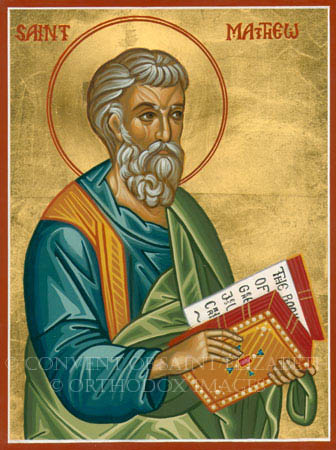
Along with the anniversary of The Hobbit, September 21st is the feast day of my patron saint—St. Matthew, Apostle and Evangelist. Before his “coming to God moment”, Matthew worked for the Roman equivalent of the IRS. Hatred of paying government taxes is an innate principle built into humanity. Palestine 30 A.D. was no different. What courage and faith it must have taken Matthew to leave his luxurious, high paying government job?

Tax collectors were considered traitors to the Jewish people. They basically did the Roman government’s dirty work of extolling individuals for money. I always imaged how Matthew would fit in with Jesus’ motley crew of Apostles. Was he accepted right away? Did trust issues exist?

While such questions are purely speculative, but I find pondering the transition of Matthew from a hated tax collector to an evangelist helpful in my relationship with my patron saint. I too struggle to fit in at times, yet I am gifted with the ability to spread the Good News of Jesus Christ just like St. Matthew! September 21st is the beginning of my re-commitment to evangelize through my writing, family life, and volunteering at my parish. I hope to exhibit the same steadfast faith as Matthew did when Jesus said, “Follow me” (Luke 5:27).

follow me.gif

September of Sacraments

Together with my patron saint and favorite fantasy jubilees occurring on the same day, the month of September started as a transitional month for my family and I. My wife began a new job, our children started to get in the school routine, and changes galore occurred at work. Through the grace of God and ability in our hectic scheduling, and mostly due to my serious need for divine assistance I went to confession twice this month.

During my first confession, the priests gave me this amazing penance—pray the Prayer of Humility. Humility is the virtue that stands in opposition to the vice of pride. Pride is what made the Devil fall from his celestial pedestal as God’s favored angel. Pride leads me to be an inferior version of myself. Let us briefly ask God for the gift of true and beautiful humility:

O Jesus! meek and humble of heart, Hear me. From the desire of being esteemed, Deliver me, Jesus.

From the desire of being loved… From the desire of being extolled … From the desire of being honored … From the desire of being praised … From the desire of being preferred to others… From the desire of being consulted … From the desire of being approved … From the fear of being humiliated … From the fear of being despised… From the fear of suffering rebukes … From the fear of being calumniated … From the fear of being forgotten … From the fear of being ridiculed … From the fear of being wronged … From the fear of being suspected …

That others may be loved more than I, Jesus, grant me the grace to desire it.

That others may be esteemed more than I … That, in the opinion of the world, others may increase and I may decrease … That others may be chosen and I set aside … That others may be praised and I unnoticed … That others may be preferred to me in everything… That others may become holier than I, provided that I may become as holy as I should…

spiritual path

Be on the Lookout for Your Unexpected Journey

Unexpected journeys are difficult, but the joy attained through its travel is immeasurable. Jesus tells his disciples [and us], “Whoever wishes to come after me must deny himself, take up his cross, and follow me. For whoever wishes to save his life will lose it, but whoever loses his life for my sake will find it” (Matthew 16:24-25). God asks us each day: will you follow me?

Starting on September 21st, 2017, I said yes! I renewed my commitment to follow His lead. Will I continue on this path? I certainly hope so, only time will truly tell. I will close with the following exchange between the hobbit and wizard before the great journey:

Gandalf: I am looking for someone to share in an adventure that I am arranging, and it’s very difficult to find anyone.

Bilbo: I should think so—in these parts! We are plain quiet folk and have no use for adventures. Nasty disturbing uncomfortable things! Make you late for dinner! I can’t think what anybody sees in them …

Gandalf: You’ll have a tale or two to tell when you come back

Bilbo: You can promise that I’ll come back?”

Gandalf: No. And if you do, you will not be the same

Related Links:

3 Similarities I Share with my Namesake— Saint Matthew

Could J.R.R. Tolkien ever be canonized a saint?

An Unexpected Journey? The Case For The Canonization Of J.R.R. Tolkien

hobbit going on an adventure.gif

Thank you for sharing!