Why the Eucharist is Most Wonderful Gift to Receive

By: William Hemsworth

On June 23 we celebrated Corpus Christi Sunday, and what a great day it was.  Though we celebrate the liturgy of the Eucharist everyday at Mass, there is a tendency to get complacent.  This seems to be our human nature, because if we do something enough we tend to go through the motions.

Eucharist

On this day the church asks us to take a step back and take a moment to remember what an awesome gift the Eucharist is.  In honor of this, I also want to take a step back to look at what scripture and the early church tells us about the blessed sacrament.

Though some terms for the Eucharist developed over time, the belief of what the Eucharist is has been around since New Testament times.  Jesus gave a speech that we call the Bread of Life Discourse in which he says that unless we eat his flesh and drink his blood that we have no life within us (John 6:53).  The synoptic Gospels of Matthew, Mark, and Luke give us the words of institution that we hear so often (Matthew 26:17-30, Mark 14:12-26, and Luke 22:7-39).

In Summary of these Jesus tells us to eat the bread and says “This is my body”.  Then he took the cup of wine and “This is the cup of my blood that was given for you”.  Notice how our Lord says “this is” and not that it is merely a symbolic action?

Catholic Eucharist meme

The real presence of Christ in the Eucharist is one that held true in the doctrine of the early church.  The big heresy going around in the first couple centuries of the church was Gnosticism.  The Gnostics believes that all matter was evil, and as such Jesus himself didn’t actually die on the cross.  Since all matter was deemed evil by the Gnostics, the Eucharist was something that was unfathomable?  After all, if matter were evil, then there was no way that the bread and wine can transform into the body and blood of Christ.

Heresy gif

The early church fathers understood the gnostic line of thinking and used the Eucharist as a way to refute them.  In approximately 107 A.D. St. Ignatius of Antioch writes in his letter to the Smyrneans, “They [the Gnostics] abstain from the Eucharist and from prayer, because they confess not the Eucharist to be the flesh of our Saviour Jesus Christ, which suffered for our sins, and which the Father, of His goodness, raised up again”.

Justin Martyr, writing around 150 A.D., states that the bread and wine changes to the body and blood of Christ upon the prayer of the priest.  In his great work titled Against Heresies, St. Irenaeus writes “the bread, which is produced from the earth, when it receives the invocation of God, is no longer common bread, but the Eucharist.”

There are many other such quotes like this span for several centuries.  One such quote comes from St. John Chrystostom who died in 407 A.D.  Describing the Eucharist the great saint states, “How many of you say: I should like to see His face, His garments, His shoes. You do see Him, you touch Him, you eat Him. He gives Himself to you, not only that you may see Him, but also to be your food and nourishment.”

Eucharist

These quotes go on and on, and through them we see that the teaching of the church from the beginning is that the Eucharist is the body and blood of Christ.  At this point you are probably wondering why I am quoting all these great saints.  Friends, my heart hurts.  For every one person that enters the Catholic church, there are six people who leave.  Why would they leave such a great gift such as the Eucharist?  When I ask those that leave, their answers range from the sexual abuse scandal to a disagreement with a priest.  However, a majority that I have spoken to leave because they do not believe what the church teaches about the Eucharist.  Some didn’t even know the church’s teaching.

Perhaps we have taken this great sacrament for granted and our actions no longer show the reverence it deserves.  Perhaps some have just been poorly catechized. Maybe it is both.  I urge you my friends to take a moment to reflect on the greatness that is the Eucharist.  The very gift of himself that our Lord gives us to nourish and strengthen us.  May we never take it for granted and show it the reverence it deserves.


About our guest blogger:

William is a convert to the Catholic faith.  Before entering the church he was ordained as a Baptist and Lutheran and earned a Master of Divinity from Liberty Theological Seminary.  William lives with his wife and four children in Tucson, AZ and teaches religious education for children and adults.  Check out his website/blog at williamhemsworth.com for more great and informative Catholic content!
Thank you for sharing!

The Concealed Power of Christian Joy Needed to be Revealed to the World!

Jesus teaches us in the Gospel for the 5th Sunday of Lent, “Amen, amen, I say to you, unless a grain of wheat falls to the ground and dies, it remains just a grain of wheat; but if it dies, it produces much fruit. Whoever loves his life– loses it, and whoever hates his life in this world will preserve it for eternal life” (John 12:24-25).

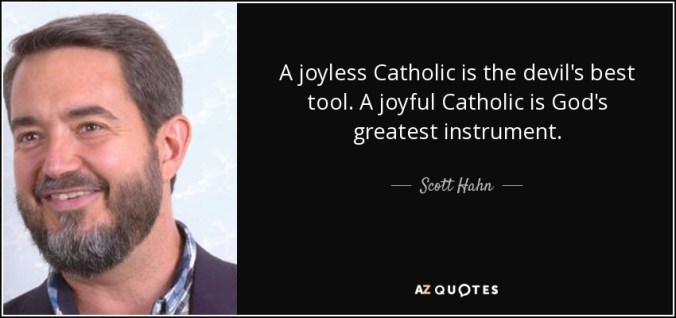
The Son of God’s words contain a message that is in keeping with his entire teaching throughout his three-year earthly ministry—sacrificial love and obedience to God brings true and lasting joy, peace, and purpose to one’s life. He also prepares us for the possibility of Heavenly joy with God in the next life. Before heading to Mass, I had few spare minutes as my children were dressed and ready for Sunday worship—that alone I thanked God as a miracle!—I perused social media and came across a meme with a quote by the acclaimed Catholic theological and biblical scholar Scott Hahn. He intrepidly declared, “A joyless Catholic is the devil’s best tool. A joyful Catholic is God’s greatest instrument.”

scott hahn joy meme

Since this morning I have contemplated his words no less than a dozen times. I cannot help to feel that God is speaking directly to me through Scott Hahn. Many things in daily living suction off joy. Tiredness, both physically and spiritual lethargy, is a key ingredient to creating a barren environment for joy to thrive. A great tactic against physical laziness is going to sound incredibly simple and obvious—mostly because a good night’s rest is the best thing to treat your body to after a long day’s work! Supplementing an increase in sleep with a better nutritional habit will combat physical weakness. Re-committing myself to a healthier lifestyle last week already proved to show gains. Increased amounts of fruits, water, and a decrease in unhealthy sugars provided me more energy throughout the day.

Along with improving the physical aspects of living, I sought out to better my spiritual well-being as well. During an afternoon jog, I had time to reflect on my spiritual progress—both for that day and how I did throughout the week. I realized that only when I put others before myself is joy even possible. First of all, I have to ask God to grant me the gift of joy. Secondly, I reminded myself to count my blessings and thank God for everything in this life: good, bad, and neutral events.

inside out joy

Joy is not a merely feeling of happiness—sorry Joy even though I loved your movie. Instead it is first and foremost a gift from God that is sustained through an attitude of gratitude. We freely receive joy as a blessing by the will of God. Our Heavenly Father God desires to bestow this gift to us as much as possible, however, he will only nurture it if we freely choose to embrace joy. The seed of Christian joy is planted when we become adopted sons and daughter through the sacrament of Baptism.

seeds-of-joy-1.jpg

Thanksgiving is the best way to foster and grow the gift of Christian joy. According to the Catechism of the Catholic Church, “the source and summit of the Christian life is the Eucharist (CCC 1324). In fact the Latin word eucharista actually means ‘thanksgiving’. While attending Sunday Mass and weekly receiving the body, blood, soul, and divinity of Jesus in the Holy Sacrament of the Altar is the fullest way to develop the gift of joy it is not the sole means. The power of Christian joy is strengthened via a regular watering of thanksgiving. Thank God for waking up, thank your family members for all the things [great and small] they do for you, thank your co-workers for helping you throughout the day, write a list of the top things/people/events that you are grateful for, or simply say “Thank you Lord!” at least once a day. All the above opportunities are ways for you to increase the joy in your life.

thank you gif 2.gif

St. Mother Teresa spoke of Christian joy in the following way, “Joy is a net of love by which we catch souls.” Let us ask for God’s grace to receive this gift to transform ourselves into a beacon of his love. I continue to thank God for the opportunity to write and share my faith. Thank you for continuing to support me in my pilgrim journey toward a joyous life.

Thank you for sharing!

3 Way to Help Christians[Really Anyone] Avoid Wandering and to Start Wondering in the Desert of Life

desert of life.jpg

The Catechism tells us, “By the solemn forty days of Lent the Church unites herself each year to the mystery of Jesus in the desert” (CCC 540). This year I already experienced time in the wilderness not only in the spiritual sense, but in a tangible way as well. As a child, I used to think that the desert only referred to geographic areas with intense heat and little rainfall. However, reflecting on the information I learned from high school geography class and confirmed by Dictionary.com, a desert technically speaking is defined as: “any area in which few forms of life can exist because of lack of water, permanent frost, or absence of soil.” Winter 2018 certainly calls into question about whether the United Stated Midwest could be argued to be categorized as a deserted place!

Along with experiencing a physical harshness of climate and barrenness of life during the wintertime, I undergo periods, especially the last couple weeks, of dryness or barrenness in my spiritual life. Spiritual aridity is a topic that I related started to learn about. Saint including, but not limited to, Teresa of Calcutta, Sister Maria Faustina, Teresa of Avila, and John of the Cross guided me toward a more mature spirituality and to realize that dryness in prayer is not necessary an indictment on a person instead souls undergo periods of purgation to deepen one’s relationship with God. St. John of the Cross, (whose feast day is actually today!) most recently helped avoid me wandering and oriented me toward a mindset that marvels at the Providence of God despite sojourning in the desert of life. Below I wish to share three specific ways Christians will be able to avoid wandering and to start wondering in the desert of life.

wonder and awe 2.jpg

  1. Omnipotent Oases: The great founding father of America Benjamin Franklin once said, “When the well’s dry, we know the worth of water.” Traveling in the desert this insight goes without saying. Quenching of thirst quickly becomes of utmost importance. In a desert certain fertile areas exist that surround a water source—oases. Venturing to an oasis is akin to the 1849 gold rush as water is an invaluable resource in a barren land. I am reminded of Jesus’ encounter with the Samaritan woman at the well in John 4. He promises her the possibility of living water. While it is not speaking of physical water, because humanity still needs that to survive the Christ is referring to the sacraments as being sources of God’s graces.

oasis-in-sahara-libiya-the-most-beautiful-place

These omnipotent oases never dry up. We need only be willing to travel to the wellsprings to receive God’s grace. According to the Catechism of the Catholic Church paragraph 1210,

Christ instituted the sacraments of the new law. There are seven: Baptism, Confirmation (or Chrismation), the Eucharist, Penance, the Anointing of the Sick, Holy Orders and Matrimony. The seven sacraments touch all the stages and all the important moments of Christian life:1 they give birth and increase, healing and mission to the Christian’s life of faith. There is thus a certain resemblance between the stages of natural life and the stages of the spiritual life.

 I wish to share an example of a recent encounter at a well of God’s grace–the Sacrament of Confession. At the conclusion of a long and particular tough week, both physically and spiritually, I realized I needed to do something about my anger issues and lack of patience at home. Traveling to a nearby local Catholic Church I confessed my sins to the priest. Standing in Personi Christi [standing in the Person of Christ] the priest had the authority to forgive my sins through the sacrament of Holy Orders. In the New Testament, Jesus conferred this power to his Apostles–the first Catholic priest– in John 20:22-23. After receiving the healing graces from this sacrament, I returned home with a greater defense and ability to encounter the temptation of anger and impatience head-on.

caravan

2. Follow the Caravan: A second tip that I discovered that helped me withstand the sandstorms [no pun intended] and desolation of life is to unite myself with others in community to not only discuss my struggles but to celebrate the joys of life. Sojourning with others assists me in the journey of life. It is not a coincidence that the source and summit of the Christian life involves communal worship in the sacrament of the Eucharist within the Mass. The Church reminds us in CCC number 1369, “The whole Church is united with the offering and intercession of Christ.”

Along with weekly attendance of  the Mass, smaller forms of community sustain me during periods of desert-like desolation in my spiritual life. A friend of mine actually reached out to me unsolicited to see if I needed assistance. “I know that you are going through a tough time now Matt, I was wondering if you wanted to get together for dinner or a drink sometime. Know that I am hear for you if you need to talk about things.” This was a text message that I received a few days ago. Truly, the Holy Spirit worked in my friend’s heart to reach out to me to seek an opportunity to console me.

moon mary.jpg

 3. Marian Moonlight in the Dark Night: The third means I learned that helped me learn to marvel at God’s majesty instead of aimlessly wander in the desert of life is turn more to the Mother of God for support and comfort. Throughout the history of the Catholic Church, the moon has be a symbol associated with Mary. Oftentimes she is a guide to pilgrims in this earthly existence during a dark night of the soul. Venerable Fulton Sheen spoke this once, “God who made the sun, also made the moon.  The moon does not take away from the brilliance of the sun.  All its light is reflected from the sun.  The Blessed Mother reflects her Divine Son; without Him, she is nothing.  With Him, she is the Mother of men.”  

Mary reflects or shines the light of Christ during the darkest of nights. During particularly frustrating nights when my children struggle with going to sleep–I ask the Blessed Virgin for assistance in my time of need. Recently, I started to pray a decade of the rosary when rocking my youngest child to bed. Looking to Mary for help is in no way a circumvention around God. I still worship Jesus Christ as my Lord and Savior, however, the humanity of Mary appeals to me and her maternal mediation always works on our behalf to bring our prayers to God.

samwise gif.gif

I will close with a quote from the J.R.R. Tolkien’s The Fellowship of the Ring: During a particularly desolate part of the journey to destroy the ring [which represents sin and corruption] the hobbit-companion to Frodo [the ring-bearer] is Samwise ‘Sam’ Gamgee. He confidently told Frod, “I made a promise, Mr Frodo. A promise. ‘Don’t you leave him Samwise Gamgee.’ And I don’t mean to. I don’t mean to.” Do we possess similar resolve when times get tough? If we are married, do we remember our marital commitment to fidelity in the good times and bad? Do we have the courage and empathy to reach out to friends in need? Let us reflect on the promise of Jesus in Matthew 28:20, “And behold, I am with you always, until the end of the age.”


Thank you for sharing!