Easter Sunday stands as the radiant heart of Christianity, the day the Church rejoices in the living truth that Jesus Christ is risen from the dead. This isn’t just a commemoration of a past event. It’s the foundation of our faith and the beginning of a new creation. As the Catechism teaches, “The Resurrection of Jesus is the crowning truth of our faith in Christ” (CCC 638). When we say ‘Christ is risen,’ we proclaim that God’s love has conquered sin and death and now invites every believer to live a new kind of life.
The Meaning of Easter Sunday
In Catholic tradition, Sunday takes on new meaning because of Easter. It is the “first day of the week,” recalling the first creation, and at the same time, the “eighth day,” symbolizing the dawn of a new creation (CCC 349). The Resurrection did not simply end something. It began something entirely new. That’s why every Sunday is, in truth, a “weekly Easter,” and why the Church gathers around the Risen Lord week after week to encounter Him at the table of the Eucharist.
Easter celebrates the Lamb of God who takes away the sins of the world. While it’s fine to enjoy the lighthearted customs of the season, like colorful eggs or the Easter bunny for the kids, it’s essential to remember that these traditions flow from the deeper mystery of Christ’s victory. The Resurrection is about real transformation. It is God’s renewal breaking into the world, into our world.
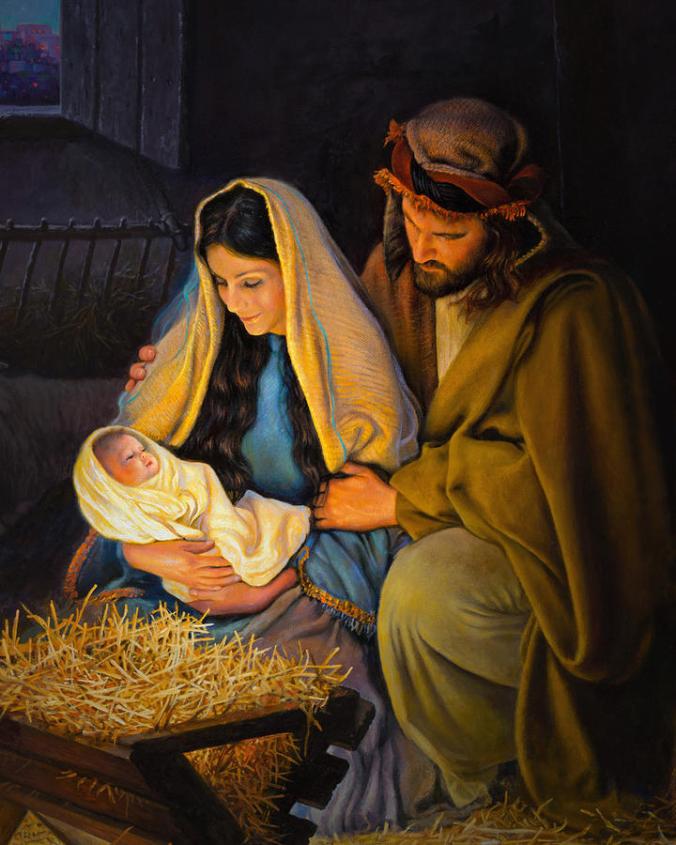
Below is a letter I dedicated to our Lord Jesus Christ in celebration of his birth, December 25, 2020 Anno Domini.
Dear Baby Jesus,
In a stable, 2000 years ago, a seemingly ordinary infant was born. Through the inspiration of the Holy Spirit, shepherds and kings from afar learned about His incredible presence. God uses the most common of circumstances to work the greatest of all miracles–the Incarnation. God so loved the world He sent you–His only Son– to bridge the great gulf, the separation caused by sin.
Wrapped in swaddling clothes, laid in a manger, you my king took the form of mankind. I have heard the Nativity story dozens of times. This Advent I feared I would take your origin story for granted. Instead, I am grateful for the opportunity to gaze on the Nativity scene through new eyes–not merely of a follower, but also as a father.
My children are a reminder of your goodness, truth, and beauty. Seeing the twinkle in their eyes when they gaze at the Nativity Scene at home or church is priceless. The smiles on my kids faces as they color “presents” pictures for my wife and I remind me the true reason for the season!
People are born everyday on this earth, but only once a year do we remember the greatest birth of all.
Jesus my servant king, Emmanuel, Prince of Peace, God-hero, I adore you and celebrate with my family and friends the anniversary of your birth. I pray that my heart is enlarged to make room within the inn of my soul for you, my family, friends, and people I meet daily!
Praised be to God in the Highest and Alleluia for our Savior’s arrival.
With great love and gratitude,
Your adopted son,
Matthew
For us men and for our salvation
he came down from heaven,
and by the Holy Spirit was incarnate of the Virgin Mary,
Every year on August 15, Catholics around the world celebrate one of the Church’s most beautiful feasts: the Assumption of the Blessed Virgin Mary. Alongside the feasts of the Immaculate Conception (December 8) and Mary, Mother of God (January 1), this is a Holy Day of Obligation, a day when we gather for Mass to honor the Mother of God.
And let’s be clear — we venerate Mary, we do not worship her. All true Marian devotion leads us closer to Jesus. The Church teaches that the mysteries of Mary’s life inseparably connect to the mystery of Christ.
The Assumption celebrates that, at the end of her earthly life, God took Mary up body and soul into heavenly glory. This is not simply a personal privilege for her: it is a sign of what God desires for all of us. The Catechism describes it beautifully: Continue reading →
Early on the history of the Catholic Church an admiration existed for Peter and Paul. Aside from Jesus Christ himself, these two men are the main characters in the New Testament. In his First Epistle to the Corinthians, church leader Clement of Rome tells of the leadership of Peter and Peter. He wrote,
There was Peter who by reason of unrighteous jealousy endured not one not one but many labors, and thus having borne his testimony went to his appointed place of glory. By reason of jealousy and strife Paul by his example pointed out the prize of patient endurance…Unto these men of holy lives was gathered a vast multitude of the elect, who through many indignities and tortures, being the victims of jealousy, set a brave example among ourselves (First Epistle of Clement of Rome to the Corinthians 5:4-6:1).
Living in the 1st century A.D., Clement’s praise of the first leaders of the Church shows something special changed these men. God selected a simple fisherman and a reformed murderer to head the Catholic Church. I believe the Holy Spirit guided the Church to forever link these two saints lives through having the same feast day on June 29th.
Creativity of Truth [Saint Paul]
Having the ability to think outside the box and preach to vastly different audiences is a gift. St. Paul possessed both creativity and the flexibility to frame his thoughts to fit the needs and understanding of his particular audiences. Writer of almost 2/3 of the New Testament, St. Paul represents the creative aspect of the Catholic faith. He brings to the table dynamic, vibrant, creative theology to teach Christians in the early Church and today.
The Apostle of the Gentile used many tangible and relatable examples to teach the faith. One of my personal favorites comes from 1 Corinthians 12. Paul clearly and succinctly communicates the fact that unity is found within diversity. He provides the analogy of the Church consisting of one body with many parts and Jesus Christ as the ultimate head of the body.
Another clear and understandable example of the love and teaching of God is St. Paul’s frequent references to Christians as adopted children of God. In Romans 8:14-17 he writes,
For those who are led by the Spirit of God are children of God.j15For you did not receive a spirit of slavery to fall back into fear, but you received a spirit of adoption, through which we cry, “Abba,* Father!”k 16The Spirit itself bears witness with our spirit that we are children of God,l 17and if children, then heirs, heirs of God and joint heirs with Christ, if only we suffer with him so that we may also be glorified with him.
Stability of Truth [Saint Peter]
Unlike Paul who represents the intellectual, creative, and theological side of truth, Peter is a model for the consistency and enduring nature of
Catholic teaching. Jesus instituted the papacy in Matthew 16:17-19. According to the evangelist the charge to the future pope went as follows,
Jesus said to him in reply, “Blessed are you, Simon son of Jonah. For flesh and blood* has not revealed this to you, but my heavenly Father. 18k And so I say to you, you are Peter, and upon this rock I will build my church,* and the gates of the netherworld shall not prevail against it. 19l I will give you the keys to the kingdom of heaven.* Whatever you bind on earth shall be bound in heaven; and whatever you loose on earth shall be loosed in heaven.
The lead up to this significant institutional passage is Peter’s realization of Jesus’ true identity as Christ. Through the guidance of the Holy Spirit, Peter led the Catholic Church after Jesus’ ascension to Heaven. He led the Council of Jerusalem in Acts 15 and displayed the ultimate mark of faith in his martyrdom. The Holy Spirit guides the papacy. This office acts as the supreme authority on matters related to faith and morality.
Analogy of Tetherball
Truth is unchanging but our understanding of truth developed over the centuries. The genius of the Catholic Church is apparent in the consolidation of Peter and Paul’s feast on a single day. There is a schoolyard game that comes to mind to describe the relationship between the first pope and the great Apostle to the Gentiles—tetherball! Incidentally, it was not until my early twenties that I discovered the joy and fun this recess game provides despite its simplistic nature. I even purchased a tetherball at my local sporting goods store in hopes to eventually install a tetherball post in my background.
To get back from my tetherball tangent, the post in this game reminds me of the stability of the papacy of St. Peter provides. The ball and rope represent the creative theology of St. Paul. Both are essential aspects of the game [and the Catholic faith].
The Stable and Creative Church
Without the stability of the papacy, truth devolves into subjectivity and confusion ensues. Likewise, an absence of dynamic theological thought [represented by Paul] leads to staleness, rigidity, and irrelevancy of Catholic teaching. Remember kids recess is an important subject in school too—you never know when you can apply lessons from leisure to real life!
Pope Francis on June 29th, 2017 stated, “The Fathers of the Church liked to compare the holy apostles Peter and Paul to two columns, on which the visible building of the Church rests. Both sealed with their own blood their testimony to Christ of preaching and service to the nascent Christian community.”
Every year, fifty days after Easter, the Church throws a birthday party of sorts. But this isn’t the kind of birthday where you blow out candles or awkwardly sing “Happy Birthday.” Pentecost marks something far more profound: the moment the Church was born through the power of the Holy Spirit.
The Upper Room: Where It All Began
Imagine the scene. The Apostles and Mary are gathered together in the Upper Room. They’re praying, waiting, wondering what comes next. Jesus had promised them a Helper—the Holy Spirit—but they probably didn’t fully grasp what that meant. Then, suddenly, a mighty wind fills the room, tongues of fire descend, and everything changes (Acts 2:1-4).
This wasn’t some private mystical experience. The Spirit’s arrival empowered the Apostles to speak in different languages, proclaiming the Gospel to people from every corner of the known world. What began as a small, frightened group of disciples instantly became a bold, Spirit-filled Church ready to take the Good News to the ends of the earth.
Pentecost: The Anti-Babel
To understand the full meaning of Pentecost, it helps to look backward—all the way to the Tower of Babel (Genesis 11). At Babel, humanity’s pride led them to build a tower to heaven, thinking they could reach God on their own terms. God confused their language, scattering them across the earth.
Pentecost reverses Babel. Instead of division, we see unity. Instead of prideful self-reliance, we witness humble reception of God’s gift. The Holy Spirit unites people of every nation, not by erasing their differences, but by enabling them to hear and understand the Gospel in their own language. Everything at Pentecost points back to this truth: all good things—especially unity—come from God.
The Church’s Distinguishing Marks Revealed
Pentecost gives us the Church’s “baby picture.” Even in her earliest moments, we can see her essential features.
Charismatic: The Church is filled with the Holy Spirit’s gifts. Tongues, preaching, healing—all flow from the Spirit’s power.
Trinitarian: The Spirit’s descent reveals the full work of the Trinity—sent by the Father and the Son (Acts 2:33-36).
Marian: Mary is present at Pentecost, just as she was present at Jesus’ conception. The Spirit overshadows both Mary and the Church, birthing Christ and His Body.
Apostolic and Petrine: The Apostles, led by Peter, proclaim the first great homily of the Church, explaining how Christ fulfills the Scriptures. Peter’s leadership demonstrates his unique role (Matthew 16:17-20).
Sacramental: Peter calls the people to repent and be baptized, receiving forgiveness of sins and the gift of the Holy Spirit (Acts 2:38-39).
Catholic: Though the first converts were Jews, they came from every nation, foreshadowing the Church’s universal mission.
Always in a Situation of Pentecost
Pentecost isn’t simply a historical event to be remembered; it’s the Church’s ongoing reality. Saint John Paul II captured this beautifully: “The Church of Christ is always, so to speak, in a situation of Pentecost: she is always gathered in the Upper Room in prayer, and at the same time, driven by the powerful wind of the Spirit, she is always on the streets preaching” (June 8, 2003).
The same Spirit that empowered Peter and the Apostles is alive and active today. The Church’s mission continues, proclaiming Christ to every nation and generation. Even now, the Holy Spirit unites us across languages, cultures, and continents as one Body in Christ.
Pentecost, Holiness, and Mission
Saint Pope John Paul II often spoke of how holiness fuels mission. The Spirit doesn’t just empower us to preach; He sanctifies us to live holy lives. As John Paul II said, each saint is “a masterpiece of the Holy Spirit.” Holiness isn’t a luxury for a select few but the ordinary path of every Christian, made possible by the Spirit working in us.
This holiness starts in prayer, continues in the sacraments, and grows through charity and humility. As the Holy Spirit moves us closer to Christ, our witness naturally overflows into mission, just as it did for the Apostles on Pentecost.
The Holy Spirit: The Hidden Gift That Makes All Things New
The Holy Spirit remains somewhat mysterious. We cannot see Him, but His effects are undeniable. Like the wind, we hear His movement and feel His presence. He empowers the Church, guides her into truth, convicts hearts, comforts the suffering, and strengthens the weak.
Pentecost reminds us that the Church’s strength never comes from programs, popularity, or human wisdom. It comes from God’s Spirit. What began in the Upper Room now radiates to the entire world—and continues today in every parish, family, and soul open to His presence.
So this Pentecost, as we celebrate the Church’s birthday, may we echo the prayer of Saint John XXIII that John Paul II often repeated:
“O Holy Spirit, Paraclete, perfect in us the work begun by Jesus… Let everything in us be on a grand scale: the search for truth and the devotion to it, and readiness for self-sacrifice, even to the cross and death.”
Editor’s Note: Article originally published in 2017.
Does Your Soul Need a Deep Clean?
My wife and I completed an intense bout of pre-spring cleaning (it was a mere 2 days before the official start of spring J) this past weekend. That coupled with a reference to avoiding desolation and clearing our soul from the “dustiness” of a dry spiritual life during my weekly parish men’s group influenced the title of this post and inspired me to write today.
I am a neat freak. In fact, one of the major three tenets my blog is based on is organization. I am passionate about decluttering, sorting, and cleaning dusty crevices in my house. Yet, when it comes to the spiritual life, why do I occasionally lack the same fervor that I have cleaning my physical house?
According to the Catechism of the Catholic Church paragraph 797,
“What the soul is to the human body, the Holy Spirit is to the Body of Christ, which is the Church.”243 “To this Spirit of Christ, as an invisible principle, is to be ascribed the fact that all the parts of the body are joined one with the other and with their exalted head; for the whole Spirit of Christ is in the head, the whole Spirit is in the body, and the whole Spirit is in each of the members.”244 The Holy Spirit makes the Church “the temple of the living God”.
The Cleansing Power of the Holy Spirit
This imagery of the Holy Spirt being housed in the church is not new. St. Paul clearly states this in 1 Corinthians 3:16 and 2 Corinthians 6:16 to name just a couple verses. However, it was through the intercession of St. Teresa of Avila’s writing that I especially encountered this truth recently.
She begins her greatest work, Interior Castle, with the following divinely inspired words, “ I thought of the soul as resembling a castle, formed of a single diamond or a very transparent crystal and containing many rooms, just as in heaven there are many mansions.”
Teresa’s description of the soul is easy for me to understand yet at the same time illustrates the complexity of our human condition.
Throughout the Interior Castle the doctor of the Church takes readers on a spiritual journey by examining how in navigating through the castle of our soul we are able to grow in closer union with God.
Saint Teresa of Avila Pray for Us
Without a thorough examination of oneself and spiritual guidance we are not able to recognize the graces God grants us daily and gives ways for us to clear out the “dustiness” of our soul. Just like how my home needs frequent seasonal cleanings, the Church in Her wisdom has seasonal cleanings as well for us to grow in holiness.
My goal is to take a few minutes each week to reflect on St. Teresa of Avila’s words in Interior Castle. I hope you all prayerfully consider to join me in this journey and cleanse your own soul of the “dustiness” of sin and temptation.
Last week, I had the incredible opportunity to attend the National Eucharistic Congress in Indianapolis. Over 50k Catholics were in attendance across the United States. Eucharistic Adoration, daily Mass and a line-up of speakers headed by Fr. Mike Schmitz and Bishop Robert Barron were the highlights (but to be honest the entire week was a highlight).
The experience was truly transformative, filled with moments of profound joy and palpable movements of the Holy Spirit. As I reflect on those days, I’d like to share some of the most impactful insights I gained.
The Joy of Christian Community
One of the first things that struck me was the overwhelming sense of joy that permeated the entire event. As I sat in the conference hall during supper, I couldn’t help but notice the many small groups of two or three people scattered throughout the room. In those moments, I felt certain that Jesus was present among them, fulfilling His promise: “For where two or three gather in my name, there am I with them” (Matthew 18:20).
A Powerful Encounter
While waiting in line for the Eucharistic Miracles exhibit (a popular attraction with over an hour and a half wait), I had a life-changing encounter. I met Emilio, a gentleman from California, whose story deeply moved me. Emilio shared how he had been involved in gang activity from a young age and had even taken a life at 22, resulting in a life sentence. Eventually, a combination of legal changes and Emilio’s profound spiritual transformation led to his release.
Emilio and I waiting in line to see the Eucharistic Miracles Exhibit.
His journey of repentance and renewal in prison led him to give his life to Jesus. Emilio’s wife, who accompanied him, emphasized that she felt the Eucharistic Congress was specifically for him. This reminded me that while we were blessed to attend, the Eucharistic Revival is for all baptized Catholics – we are all called to share the Gospel and live sacramentally.
The Power of Jesus’ Name
Another powerful realization came during Dr. Mary Healy’s talk on healing and prayer. The healing service she conducted with Fr. Mathias Thelen felt biblical in its intensity, reminiscent of Jesus’ own ministry. During this service, I experienced firsthand the power of prayer and the name of Jesus.
Jesus is Lord. 🍞🍷✝️🙏
Despite initial doubts about whether my relatively minor headache was worthy of divine intervention, I prayed, “Lord, help my unbelief” – echoing the father in Mark 9:24. To my amazement, as the service concluded, I realized my headache had disappeared. This experience reinforced the truth that Jesus has the power to heal us physically, mentally, and spiritually – just as He did in biblical times. Jesus is the Divine Physician and He desires to heal all our wounds.
The Importance of Repentance
A recurring theme throughout the Congress was the significance of repentance. According to Fr. Mike Schmitz, “If this is going to be a revival, if it’s going to be a real revival, here’s the reality. In the history of Christianity, you can never have a revival without repentance.”
To fully receive the graces available in the Sacrament of the Eucharist, we must approach it with hearts open to God’s mercy. But this mercy is not forced upon us. We have to repent of our sins. The Catechism of the Catholic Church puts it this way, “Jesus calls to conversion. This call is an essential part of the proclamation of the kingdom: ‘The time is fulfilled, and the kingdom of God is at hand; repent, and believe in the gospel” (CCC 1427).
This emphasis on repentance serves as a powerful reminder of our continual need for God’s mercy and our call to ongoing conversion.
Go Forth and Preach the Gospel
The National Eucharistic Congress was a profound reminder of the living presence of Christ in our midst, particularly in the Eucharist. It reinforced the power of community, the importance of personal testimony, the reality of divine healing, and the necessity of repentance in our spiritual lives.
As we move forward in this Eucharistic Revival, may we all be renewed in our commitment to Christ, open to His healing power, and ready to share His love with the world. The revival is not just for those who attended the Congress – it’s for every baptized Catholic. We are all called to live out our faith in a sacramental way, drawing strength from the Eucharist and sharing the Good News with those around us. I will see you all in the Eucharist!
Share Your Eucharistic Encounter
These testimonials offer just a glimpse of the countless ways Jesus touched hearts during the Congress. If you attended the National Eucharistic Congress, I invite you to continue this chain of witness:
Take a moment to reflect on your experience. How did you encounter Jesus during the Congress? What moment stands out as particularly meaningful or transformative?
I encourage you to write a short paragraph (100-200 words) sharing your personal encounter with Jesus at the Congress. You might consider:
A specific event or talk that moved you
A moment of prayer or adoration that was especially powerful
An unexpected encounter or conversation that touched your heart
How the Congress has changed your perspective on the Eucharist