Carrying Our Cross: Embracing Christ’s Call to Follow

A reflection on the Gospel of Luke 14:25-33

Brothers and Sisters in Christ,

Let us give our LORD God thanks, praise, and glory for sending us His only beloved Son, Jesus. Through the Holy Spirit, we acknowledge Christ’s living presence among us as we gather in prayer this hour. Jesus—our Teacher, Mentor, and Best Friend—is here right now, listening to our words and thoughts, walking with us through every joy and struggle, always loving us and drawing us closer to God.

Imagine yourself sitting beside the Lord, leaning in as He speaks words that pierce right to the heart: “My son, my daughter, I love you so very much and am always with you. Come and follow me, and together our hearts shall become one; one with our Father in heaven, united with the Holy Spirit.” This is the invitation Jesus offers every time we meet Him—whether in prayer, in adoration, or reflected in the faces of those around us. He calls us to a relationship where He comes first, a relationship that transforms us from the inside out.

Continue reading
Thank you for sharing!

The Way Up Is Down: Humility, Grace, and the Heart of Christ  

A Reflection on the Gospel of Luke 14: 1, 7-14 

Brothers and Sisters in Christ, 

Today, as we gather in the presence of our Lord Jesus—our Teacher, our Master, and our very Best Friend—let’s do something that’s actually pretty simple but surprisingly hard: let’s just sit with Him. Imagine Him right next to you. Not far off, not just a story in a book, but close. Quiet. Gentle. Listen for the voice that speaks to your heart, the one that says, “My son, my daughter, I love you so very much and am always with you. Come and follow me on the path of righteousness—loving our Father in heaven wholly, and loving those around us as I love you. And together, our hearts shall become one; one with our LORD God and with the Holy Spirit.” 

The Gospel’s Upside-Down Wisdom: Humility, Mercy, and God’s True Economy   

In today’s Gospel from Luke, chapter 14, Jesus gives us a warning and a promise. He says, in effect, “The way up is down. If you want real glory, don’t chase it. Be humble. Love others.” And He doesn’t just say this—He lives it. The Holy Spirit draws us into the very shape of Jesus’ own life: His humility, His suffering, His rising again. It’s right there at the center of the Gospel: if you want to be free, if you want to be blessed, put others ahead of yourself. 

Picture the scene. Jesus is at a fancy dinner thrown by a Pharisee. Everyone’s jostling for the best seats, hoping to be noticed, to be important. Jesus watches this and tells them a story that flips everything. Don’t try to grab the seat of honor. Take the lowest place. If you belong higher, you’ll be called up—and you won’t have to be embarrassed. “Everyone who exalts himself will be humbled, but the one who humbles himself will be exalted.” It’s simple, but it’s the opposite of how we’re wired. 

Then Jesus goes further. He says, “Don’t invite people who can pay you back. Invite the poor, the crippled, the lame, the blind.” And He promises a different kind of reward: “You will be repaid at the resurrection of the righteous.” What does this mean? It means God’s kingdom runs on a different economy than ours. It’s not about keeping score. It’s about mercy. About giving without keeping track. 

The Paschal Mystery: Christ’s Humility, Self-Emptying Love, and the Grace of the New Covenant 

Let’s tie this to the heart of our faith—the Paschal Mystery. That’s the passion, death, resurrection, and ascension of Jesus. The whole thing is about self-emptying love. Humility wasn’t just something Jesus taught. It was something He lived all the way to the cross. As Paul writes in Philippians, “Though he was in the form of God, he did not regard equality with God as something to be grasped, but emptied himself, taking the form of a slave, being born in human likeness. And being found in human form, he humbled himself and became obedient to the point of death—even death on a cross.” 

The cross is the lowest place. Jesus goes there for us, for people who could never pay Him back. And because of this, the Father raises Him up. That’s the pattern: humble service leads to real glory. Not just for Jesus, but for us, if we follow Him. 

This is the New Covenant. It’s not a business deal with God—“I do good, God rewards me.” It’s about grace. We don’t earn our spot at God’s table; we’re invited because He loves us. And we’re called to treat others the same way. Invite, serve, love—especially those who can’t give us anything in return. 

Living Humility Day by Day: Trusting the Spirit and Serving Like Jesus 

So, what does this look like in real life? First, ask for the Holy Spirit’s help. We can’t do this on our own. Ask the Spirit to make us more like Jesus, to help us live and love as He did. Practice humility—listen before you speak, serve rather than be served, celebrate others’ successes. Reach out to the overlooked and the lonely, not because there’s something in it for you, but because that’s what Jesus does. Check your motives—“Am I doing this to be seen, or out of genuine love?” And trust God with your honor. Let go of needing immediate praise. God sees. He knows. 

This isn’t just about table manners. It’s about how we live, how we see ourselves, how we treat every person we meet. Jesus wants us to look at others as He does, to serve generously, expecting nothing in return. 

As we follow Jesus, the Holy Spirit shapes us. We become children of God, and we trust Him with our lives. We’re not alone. The Spirit helps us live generously and humbly—even when it isn’t easy. 

So, at a dinner where everyone wanted the best seat, Jesus flipped the script. He taught that greatness is found in choosing the lowest place. He called us to love those who can’t repay us, to welcome the poor and forgotten, to give without expecting anything back. That’s how we follow Jesus. That’s how we let the Holy Spirit make us into people who see every neighbor with God’s eyes. 

Let’s remember those words from Jesus: “I love you, my son. I love you, my daughter. I am always with you.” Go, give praise, thanksgiving, and glory to God. Love and serve those around you, putting each person ahead of yourself, building up the Body of Christ, living in the Kingdom of heaven, and saying yes to God’s will. 

Amen. 

Amen.

About Live the Eucharist

About Our Guest Blogger

Blessed Carlo Acutis once said, “Not me, but God.” His words echo deeply in my own spiritual life. This blog is not about me, but about the work of the Holy Spirit. I choose to remain anonymous because the voice behind these reflections isn’t what matters — the One speaking through them is.

I am a lifelong Catholic with a deep love for Scripture, the sacraments, and the quiet ways God speaks through everyday life. Live the Eucharist was born from my desire to share how the Gospel and the Eucharist shape not just my Sundays, but every step of the journey.

My hope is that these reflections bless you, challenge you, and draw you closer to Jesus — truly present in the Eucharist and profoundly present in your daily life.

Thank you for sharing!

Saint John the Baptist: The Humble Harbinger to Jesus

Every year on June 24th, Catholics celebrate the feast day of Saint John the Baptist, honoring his birth. It is a unique celebration, as Saint John is the only saint, aside from the Virgin Mary, whose birth is celebrated in the liturgy. This special observance is closely connected to the profound mystery of the Incarnation of the Son of God.

The Humility of Saint John

Saint John the Baptist, as the last prophet of the Old Testament and the one who inaugurated the New Testament, played a significant role in God’s plan of salvation. The four Gospels emphasize his figure, particularly as the prophet who identified Jesus of Nazareth as the Messiah, the Anointed One of the Lord. Despite his crucial role in preparing the way for Jesus, Saint John always remained humble and acknowledged the increasing prominence of Jesus in his own diminishing role.

The Witness to Truth

Even before his birth, Saint John demonstrated his unique connection to Jesus. According to the Catechism of the Catholic Church paragraph #523,

“St. John the Baptist is the Lord’s immediate precursor or forerunner, sent to prepare his way. ‘Prophet of the Most High’, John surpasses all the prophets, of whom he is the last. He inaugurates the Gospel, already from his mother’s womb welcomes the coming of Christ, and rejoices in being “the friend of the bridegroom”, whom he points out as “the Lamb of God, who takes away the sin of the world”. Going before Jesus “in the spirit and power of Elijah”, John bears witness to Christ in his preaching, by his Baptism of conversion, and through his martyrdom.”

Pope Benedict XVI noted, the Gospels place great emphasis on Saint John the Baptist, who, as the final prophet of the Old Testament, identified Jesus as the long-awaited Messiah. Saint John’s birth is intrinsically linked to the mystery of the Incarnation of the Son of God, making him a witness to the divine truth.

Embracing the Bizarreness of the Gospel

Saint John the Baptist’s unconventional appearance and lifestyle in the desert might have seemed peculiar to those who did not believe. However, as Pope Benedict XVI pointed out in his Angelus on June 24, 2012, Saint John’s role as the prophet who concluded the Old Testament and introduced the New Testament was of utmost significance. His distinct clothing and dietary choices served as visible signs of his commitment to proclaiming God’s message and preparing the way for Jesus, even if they appeared unusual to the outside world.

Emulating Saint John

In our own lives, we are called to be like Saint John the Baptist. We are not expected to adopt his peculiar habits, but rather to follow his example of humility and witness to the truth. Saint John’s words, “He must increase while I must decrease,” resonate deeply. They remind us to let go of our pride and self-centeredness, allowing Jesus to take center stage in our lives.

The Humanity of Jesus

A profound illustration of the relationship between Jesus and Saint John can be found in Matthew 14:22-36. This passage, as Pope Benedict XVI highlighted, shows Jesus’ humanity through his experience of grief and loss following the beheading of his cousin and friend, Saint John. Even in moments of great sadness, Jesus sought solace in prayer and demonstrated the power of faith by performing miracles.

Conclusion

As we celebrate the feast day of Saint John the Baptist, we are reminded of his humility and his vital role as a witness to the truth of God’s plan for salvation. Just as Saint John recognized Jesus as the Messiah, may we also embrace the divine truth in our lives and strive to emulate his humility and unwavering commitment to God. Let us allow Jesus to increase in our lives as we decrease, making room for His love and grace to transform us.

Thank you for sharing!

An Unexpected Journey- How September 21st, 2017 Became the New Start to My Spiritual Life

hobbit gif.gif


Editor’s Notes: Originally published September 22nd, 2017


Over the past few weeks, life has been throwing stress-filled curveballs at me. Reeling from anxiety, anger, and frustration, I recently went to the spiritual medicine box—Confession—to gain sacramental graces to help me grow in patience and perspective. I experienced a true transformation in my life this week in the days following my reconciliation with God, the Church, and my fellow man. September 21st, 2017 became a new launching point for my spiritual journey. Excited for this re-start on my path toward Christian holiness, I will provide a few reasons why this date holds a special place in my heart.

The hobbit book

Anniversary of the Publication of The Hobbit

Eighty years ago, on September 21st, 1937, The Hobbit—an essential item on any fantasy fan’s bookshelf—was published. Eight decades later the tale of J.R.R. Tolkien still instills wonder in its readers.

Regrettably, I did not explore Middle Earth until my mid-20s. Over the past five years, I have read The Hobbit twice and The Lord of the Rings trilogy once.

A true literary treasure is measured through its ability to stand the test of time. Nearly a century later, I would say that Tolkien’s work passes with flying colors. Characters within the story seem to speak directly to me. For instance, the dwarf Thorin tells Bilbo, “There is more in you of good than you know, child of the kindly West. Some courage and some wisdom, blended in measure. If more of us valued food and cheer and song above hoarded gold, it would be a merrier world.” How easy is it for us to lose memory of the importance things in life? I forget fairly quickly. Tolkien reminds me to look for the hidden joys in my life. Perhaps, an unexpected journey is in store for me starting September 21st, 2017.

St. Matthew

Happy Holiness Day

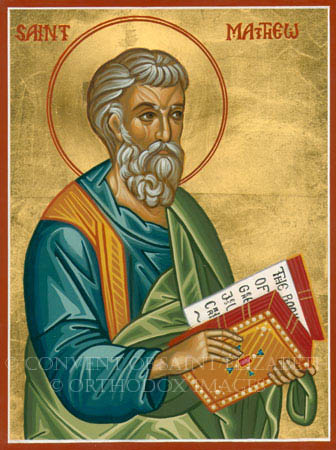
Along with the anniversary of The Hobbit, September 21st is the feast day of my patron saint—St. Matthew, Apostle and Evangelist. Before his “coming to God moment”, Matthew worked for the Roman equivalent of the IRS. Hatred of paying government taxes is an innate principle built into humanity. Palestine 30 A.D. was no different. What courage and faith it must have taken Matthew to leave his luxurious, high paying government job?

Tax collectors were considered traitors to the Jewish people. They basically did the Roman government’s dirty work of extolling individuals for money. I always imaged how Matthew would fit in with Jesus’ motley crew of Apostles. Was he accepted right away? Did trust issues exist?

While such questions are purely speculative, but I find pondering the transition of Matthew from a hated tax collector to an evangelist helpful in my relationship with my patron saint. I too struggle to fit in at times, yet I am gifted with the ability to spread the Good News of Jesus Christ just like St. Matthew! September 21st is the beginning of my re-commitment to evangelize through my writing, family life, and volunteering at my parish. I hope to exhibit the same steadfast faith as Matthew did when Jesus said, “Follow me” (Luke 5:27).

follow me.gif

September of Sacraments

Together with my patron saint and favorite fantasy jubilees occurring on the same day, the month of September started as a transitional month for my family and I. My wife began a new job, our children started to get in the school routine, and changes galore occurred at work. Through the grace of God and ability in our hectic scheduling, and mostly due to my serious need for divine assistance I went to confession twice this month.

During my first confession, the priests gave me this amazing penance—pray the Prayer of Humility. Humility is the virtue that stands in opposition to the vice of pride. Pride is what made the Devil fall from his celestial pedestal as God’s favored angel. Pride leads me to be an inferior version of myself. Let us briefly ask God for the gift of true and beautiful humility:

O Jesus! meek and humble of heart, Hear me. From the desire of being esteemed, Deliver me, Jesus.

From the desire of being loved… From the desire of being extolled … From the desire of being honored … From the desire of being praised … From the desire of being preferred to others… From the desire of being consulted … From the desire of being approved … From the fear of being humiliated … From the fear of being despised… From the fear of suffering rebukes … From the fear of being calumniated … From the fear of being forgotten … From the fear of being ridiculed … From the fear of being wronged … From the fear of being suspected …

That others may be loved more than I, Jesus, grant me the grace to desire it.

That others may be esteemed more than I … That, in the opinion of the world, others may increase and I may decrease … That others may be chosen and I set aside … That others may be praised and I unnoticed … That others may be preferred to me in everything… That others may become holier than I, provided that I may become as holy as I should…

spiritual path

Be on the Lookout for Your Unexpected Journey

Unexpected journeys are difficult, but the joy attained through its travel is immeasurable. Jesus tells his disciples [and us], “Whoever wishes to come after me must deny himself, take up his cross, and follow me. For whoever wishes to save his life will lose it, but whoever loses his life for my sake will find it” (Matthew 16:24-25). God asks us each day: will you follow me?

Starting on September 21st, 2017, I said yes! I renewed my commitment to follow His lead. Will I continue on this path? I certainly hope so, only time will truly tell. I will close with the following exchange between the hobbit and wizard before the great journey:

Gandalf: I am looking for someone to share in an adventure that I am arranging, and it’s very difficult to find anyone.

Bilbo: I should think so—in these parts! We are plain quiet folk and have no use for adventures. Nasty disturbing uncomfortable things! Make you late for dinner! I can’t think what anybody sees in them …

Gandalf: You’ll have a tale or two to tell when you come back

Bilbo: You can promise that I’ll come back?”

Gandalf: No. And if you do, you will not be the same

Related Links:

3 Similarities I Share with my Namesake— Saint Matthew

Could J.R.R. Tolkien ever be canonized a saint?

An Unexpected Journey? The Case For The Canonization Of J.R.R. Tolkien

hobbit going on an adventure.gif

Thank you for sharing!

Reflections on Saint John Henry Newman’s Lenten Sermon

Sermons

According to the English Catholic priest-cardinal John Henry Newman, “Growth is the only evidence of life.” Life is then most apparent in the springtime with the bursting and budding of flowers, trees, and whistling of birds. Winter precedes this era of new life. Is it not interesting that within nature newness of life springs forth from the cold, dark, dreariness of the death of winter?

Currently, we live in a time of transition—March, the chimeric month whereby it begins calmly like a lamb and ends ferociously like a lion or vice versa!

A Transitional Season

The Holy Spirit guided the Early Church in placing Lent during the lowest point (CLIMATICALLY SPEAKING) of the calendar year.

harshness of cold gif.gif

Lent is a time of wandering in the hope it leads to the wonderment of Easter Sunday. Saint John Henry Newman began his Sermon for the First Sunday of Lent with this key reminder, “The season of humiliation, which precedes Easter, lasts forty days, in memory of our Lord’s long fast in the wilderness.” When you actually think about it, wintertime can be a source of humiliation as well.

slipping on ice gif.gif

Tired from the lack of sunlight and seemingly endless shoveling you may oversleep your alarm clock and rush out the door to work. In that panic of celerity, you may have slipped on a patch of ice and fell quickly on your butt— all the while your careful neighbors gaze at you! Well, this actually happened to me, except instead it happened in the busy parking lot of a grocery store! I felt quite foolish and embarrassed. Our 40-day sojourn in the “desert” is a call to unite ourselves in prayer and fasting to Christ’s ultimate humiliation—His violent death on the Cross.

Excerpt from Newman’s Lenten Homily:

For what we know, Christ’s temptation is but the fulness of that which, in its degree, and according to our infirmities and corruptions, takes place in all His servants who seek Him. And if so, this surely was a strong reason for the Church’s associating our season of humiliation with Christ’s sojourn in the wilderness, that we might not be left to our own thoughts, and, as it were, “with the wild beasts.”

Humble Yourself this Lent

Again, the holy priest guides us to focus on Lent as a time to link our personal embarrassment with Jesus’ humble time in the desert. God so loved the world that He gave His only Son Jesus. Jesus endured human things like hunger, thirst, and temptation. Fully human. But fully divine too. Christ never succumbed to the wiles of the Devil. Saint Newman reminds us to humble ourselves before the foot of the Cross.

eucharist


May we endure the harsh realities of this wintery world through the refreshing oases of the sacraments this Lenten season. Read the Saint John Henry Newman’s entire sermon here: John Henry Newman’s Lenten Sermon.

Related Links

A pick-me-up from Cardinal Newman to keep up your Lent

Lent 2022: The Complete Guide to the Catholic Season of Lent

40 Facts You Wished Everyone Knew About Lent

Introducing Best Lent Ever: Dynamic Catholic

Thank you for sharing!

2 Ways I Relate to Max Lucado’s You are Special

you are special


Editor’s Note: This post was originally published on November 14, 2017.


John Paul II in his 1995 encyclical letter Evangelium Vitae reminds us, “when the sense of God is lost, there is also a tendency to lose the sense of man, of his dignity and his life; in turn, the systematic violation of the moral law, especially in the serious matter of respect for human life and its dignity, produces a kind of progressive darkening of the capacity to discern God’s living and saving presence” (no. 21). Admittedly, I have seen the danger of the reduction of humanity which results in a loss of dignity of the individual person. Days when I struggle with patience, I sometimes reduce my children as tasks to be managed and the ultimate goal is getting them to bedtime by the arbitrary deadline I impose on the family.

Obsessing over Human Praise

As a person with OCD, it is a daily battle to combat my compulsive urges for order and stability. Unfortunately, my control-everything mindset does not simply reside in my home-life—it seeps into the workplace as well. I get to be so goal-driven and task-oriented that sometimes I miss the entire purpose of my job [and well, any job for that matter]—to help others! Over the past couple weeks, I sought out acknowledgement from the superiors in my department and I got a little frustrated when I did not constantly receive “corporate praise”.

Saint Teresa of Avila once said, “There is more value in a little study of humility and in a single act of it than in all the knowledge in the world.” I would do well to heed this advice. I am grateful I came across the saint’s words as I began a fresh week. Focusing on the virtue of humility got my mind thinking. Eventually, my thoughts landed on a book from our living room bookshelf—Max Lucado’s You are Special. This is a story that I relate to more and more with each passing year. God mysteriously stirred the story of the Wemmicks in my long-term memory bank to remind myself the true meaning of life! Let me explain:

god be merciful

God is a Merciful Judge

The tale begins with the average day for wooden creatures known as Wemmicks. Tirelessly, grey dots and golden stars are being placed on each individual. Dots represent a defect in a Wemmick whereas stars signify a positive attribute. All the Wemmicks were created by the same woodcarver—Eli. Punchinello is a Wemmick who receives only grey dots—and a lot of them! He encounters an unblemished Wemmick without the stain of either dots or stars. Punchinello learns that visiting Eli on his hilltop residence grants Wemmicks the knowledge that they do not have to be defined by the type of markings they gave each other. We even discover Eli’s love prohibits dots or stars from sticking to the wooden creatures!

An obvious allegory for the Christian life, I am reminded that any good reward [or lack thereof] I receive at work does not increase or decrease my dignity as a human person or as an adopted son of God. God is a merciful judge. He allows every day to be a new opportunity to love Him and to love my neighbor. The reception of confession is a powerful tool I have utilized in the past couple months to help combat my scrupulosity.

joey door locked on inside gif.gif

Doors of Hell are Locked from the Inside

A second lesson gained from You Are Special is that it is my own pride and limited world outlook that prohibits me from experiencing a foretaste of Heaven in this life. I am reminded of the famous quip of C.S. Lewis about the Afterlife, “The doors of hell are locked from the inside!” What this means is that the misery and despair of hell—that is existing apart from God—is self-imposed. I certainly experienced a hellish existence over the past three weeks. I sought to gain control over both work and home. This caused me to veer off the road of holiness . Max Lucado’s book reminded me that despair may be cured with a visit to my Heavenly Father. I need only to give permission to the Holy Spirit to enter into me.

you are special too

You are special. I am special. It’s easy to forget God’s merciful love. I will conclude with the Act of Contrition to remind us of God’s mercy and forgiving nature:

O my God, I am sorry for my sins because I have offended you. I know I should love you above all things. Help me to do penance, to do better, and to avoid anything that might lead me to sin. Amen.


Thank you for sharing!

3 Reasons Humility is Practical and Reliable


Editor’s Note: This post was originally published on April 18, 2019.


Opening my email inbox I noticed a correspondence from a resume-building website titled Your Resume Review is Complete. Quickly, I clicked on the email to see how I compared to other job seekers. Needless to say, my feedback shows that I have much room for improvement. My initial reaction to the review included feelings of dejection, inadequacies, and defeat. On top of these negative feelings my toddler son began a 10 minute tantrum. “Today is going to be one of those days,” I thought.

Author Erwin McManus wrote, “Attitude is an accurate monitor of where we fall on the spectrum of pride and humility.” Normally, my virtue-vice needle points closer to the pride side. Today was different though. Although my natural reaction tended toward despair which is a product of pride, that soon dissipated towards a desire to learn and improve on my resume — I realized I’m not the smartest when it comes to professional resume building!cs lewis humility


According to C.S. Lewis, “Humility is not thinking less of yourself, it’s thinking of yourself less.” The old me would tend toward despair with any type of constructive criticism. My primary focus has been to improve my spiritual life—I need to limit my impatience, pride, and anger when things get outside of my control.

Reading St. Louis de Montfort’s The Secret of the Rosary deepened my devotion to Mary. Aside from Jesus, no other person exhibits humility as much as the Queen of Humility. Along with spiritual benefits of humility this virtue provides practicality and reliability to daily life.

Time-saver

Ralph Waldo Emerson plainly wrote, “For every minute you remain angry, you give up sixty seconds of peace of mind.” The times I most often get angry is when something does not go MY way. Whenever I have the prideful audacity to believe that I am in 100% total and utter control of my day is usually the day that nothing I want gets done. Humility is the antidote to pride. Patience is also a cousin of the virtue of humility. During the more stressful parts of parenting, I noticed that whenever I exercise patience I actually end up saving time in the long-run.

Improved relationships

Along with saving time, the virtue of humility helps and strengthens relationships. One does not need to look far to see how the virtue of humility helps. The department for the company that I work for holds a monthly meeting to detail the progress over the past 30 days. Together with the business achievements, managers recognize employers who excelled that particular month. Without exception, the workers who receive Team Member of the Month have been dutiful and humbly going about their work without the promise for recognize. Such individuals have strong relationships with their peers.

don't brag gif


Not only does the virtue of humility apply to healthy and successful profession relationship, but it is essential for family life as well. St. Teresa of Avila declared, “There is more value in a little study of humility and in a single act of it than in all the knowledge in the world.”

All the books on marriage preparation or counseling will strengthen your marriage as much as your willingness to humble yourself before your spouse. St. Paul details the characteristics of love in 1 Corinthians 13. While he does not specifically use the word humility it is clear that exercising that virtue will only benefit spouses.

Buoy during Life’s Storms

buoy during storms


Together with helping you move on from stressful situations easier and fostering relationships, the virtue of humility acts as a benevolent beacon to guide you through all of life’s storms. A common reaction toward the pressures, woes, and calamities of life is to flee. Developing the strength to withstand the maelstroms of misery takes time and patience.

The great Chinese philosopher Confucius wrote, “Humility is the foundation of all virtues.”

St. Bernard of Clairvaux recognized the importance of humility as well as he famously declared, “The three most important virtues are humility, humility, and humility!”

From my own experience the instances where I weathered the storms best occurred whenever my wife and I were both on the same page–sharing the same goal and purpose. Through humbling myself to recognize the merits of her insight was I able to lift her up [and she lifted up me] during the tumultuous times.

No matter what stage or circumstance you are at in life the virtue of humility will always be reliable and practical—on a daily basis! A trusted resource I use whenever the tentacles of pride try to take over my life is the Litany of Humility. Be prepared for this powerful prayer to change your life!

Thank you for sharing!