Controlling the Unexpected


Editor’s Note: Post originally published on August 21, 2018.


According to 18th-century British poet Alexander Pope, “Blessed is he who expects nothing, for he shall never be disappointed.” As a perfectionist who thrives on routine, my immediate reaction is to bristle at those words. I prefer order, structure, and clear expectations, and I don’t always respond gracefully when my plans unravel.

Yet, I’ve found myself challenged more and more to stretch beyond my preferences, especially when the unexpected barges in. I’m learning that growth often comes precisely when we release our white-knuckle grip on control.

Humanity as a whole tends to lean toward predictability. We crave the comfort of habit and routine. So when life throws a curveball, our instinct is to protest. We ask why. We question the timing. We may even resent the disruption.

A recent example: the changes to the Catechism of the Catholic Church regarding the death penalty. I won’t get into that debate here (maybe in a future post), but the intensity of the reaction—especially online—shows how unsettled we become when the Church, or life itself, seems to deviate from the script we’ve written in our heads.

Our Desire for Control vs. God’s Plan for Freedom

C.S. Lewis offers a piercing insight into our attempts to “manage” the messiness of life. In A Grief Observed, he wrote:

“We were promised sufferings. They were part of the program. We were even told, ‘Blessed are they that mourn,’ and I accept it. I’ve got nothing that I hadn’t bargained for. Of course it is different when the thing happens to oneself, not to others, and in reality, not imagination.”

That last line is especially humbling. It’s easy to accept the theology of suffering in the abstract, much harder when it knocks on your door personally. We want life on our terms—timed, tidy, and manageable. But even the names of things, like “Planned Parenthood,” hint at our desperate desire to domesticate what was never meant to be controlled.

Of course, God could have made us automata. But He didn’t. He gave us something far riskier: freedom. And with freedom comes the possibility of evil, but also the possibility of love.

Lewis captures this tension perfectly in The Case for Christianity:

“Why, then, did God give [us] free will? Because free will, though it makes evil possible, is also the only thing that makes possible any love or goodness or joy worth having… A world of automata, of creatures that worked like machines, would hardly be worth creating.”

Love Is Worth the Unexpected

After a long week of wrangling my three kids—taking them to the park, refereeing their arguments, picking up toys for the 100th time, and navigating bedtime for the 1,000th—it’s easy to feel drained. Exhausted, I find it hard to be fully present to my wife.

That’s when I notice the tension: am I seeking to control the bedtime routine, or am I trying to love my family well?

When I get too fixated on control, when I parent from anxiety instead of love, I actually lose control. Love involves letting others act freely within good boundaries. God, as the perfect Father, models this. He allows us the freedom to accept or reject His love. And yet, He never stops inviting.

When I allow room for the unexpected—bedtime detours, messy prayers, spontaneous laughter—I often find that love shows up in surprising ways. And that’s the real goal: to choose love over rigid control, every day.

The Creativity of the Creator

Love not only invites freedom; it also sparks creativity. And creativity suffers when we try to control everything.

When I think of the most creative people I know—whether Einstein, Tolkien, Edison, or my own children—there’s always a spark of freedom, wonder, and play. Creation isn’t born from fear or calculation. It’s born from love, vision, and a willingness to embrace risk.

Genesis 1 reminds us that God is not an indifferent architect. He is an attentive, joyful Creator, delighting in both the vastness of the stars and the details of sparrows. That divine creativity continues through us, His creatures. I see it daily in the Lego towers my kids build, the “dance parties” they host with stuffed animals, the wild adventures they imagine.

Of course, some boundaries are needed. Rules and routines help children (and adults) flourish. But when control reigns supreme, we risk choking the life out of joy.

Control Is Not the Goal

J.R.R. Tolkien put it bluntly:

“The most improper job of any man, even saints… is bossing [controlling] other men. Not one in a million is fit for it, and least of all those who seek the opportunity.”

That includes bossing around our own lives.

I’m not saying we should throw structure out the window. Discipline matters. Planning has its place. But if we cling to control as the ultimate good, we start to treat people—including ourselves—like problems to solve instead of persons to love.

The Church teaches that the purpose of life is to know, love, and serve God. We do this best when we allow His grace to surprise us. When we stop demanding control and start delighting in the unexpected, we find glimpses of heaven in the ordinary.

Maybe Pope was right after all: “Blessed is he who expects nothing…” Not because we aim low, but because we open ourselves to whatever God has planned.

And in His hands, even the unexpected is worth it.

Thank you for sharing!

The Little Way of the Hobbit: Celebrating Tolkien Day

January 3rd celebrates two important events: the Feast of the Holy Name of Jesus and the anniversary of the birth of J.R.R. Tolkien. As a Catholic obvious the former has to take precedence, I mean Jesus is the center of the Catholic faith. However, I think it is ironic, maybe even providential, of the placement of the great English literary figure’s birthday within the season of Christmastide. The famed creator of Middle Earth himself was a devout Catholic and belief in Jesus Christ permeated his entire life. I admire Tolkien because of his creativity, devotion, and ability to invoke joy into my life simply by reading his works or striking up a conversation with a random stranger about his life!

Recently, I wrote an article published in EpicPew.com discussing the reasons for canonizing Tolkien as a saint of the Church. According to the Baltimore Catechism paragraph 215 answered the question of why Catholics honor saints in this way,

“We honor the saints in heaven because they practiced great virtue when they were on earth, and because in honoring those who are the chosen friends of God we honor God Himself.”

The excitement, peace, and joy I receive when reading, researching, or talking about Middle Earth ultimately is aimed at a higher reality–a deeper reality of full communion with God in Heaven.

Thank you for sharing!

Lewis, Tolkien, and the Creative Power of Music


Editor’s Note: Post originally published on May 26, 2019.


Music is powerful. Something inherently in music provides peace and joy amidst stress and turmoil. At least that is the experience I have when listening to music. There exists a certain universal quality to music that draws all mankind together. Below I will provide examples from literature and the tradition of Catholic Church to show evidence of music’s capacity to unite people through its creative power.

Aslan’s Aria

Similar to the creation story in the Book of Genesis, the creation of Narnia takes place through the creative voice of Aslan [God]. Here is a brief excerpt from The Magician’s Nephew which gives the reader a glimpse into the inception of Narnia,

Aslan Sings to Create Narnia

A voice had begun to sing. It was very far away and Digory found it hard to decide from what direction it was coming. Sometimes it seemed to come from all directions at once. Sometimes he almost thought it was coming out of the earth beneath them. Its lower notes were deep enough to be the voice of the earth herself. There were no words. It was hardly a tune. But it was beyond comparison, the most beautiful sound he had ever heard.

Words, especially clothed in music, possess a dynamic quality in C.S. Lewis’ Chronicles of Narnia. Reading Aslan’s Aria moved me. I felt closeness to Lewis’ literary universe and a pull to experience the transcendence of God through music.

Evidence from The Silmarillion

According to Peter Kreeft, in The Philosophy of Tolkien: The Worldview Behind The Lord of the Rings, “The most powerful and magical of language is music. The reason for this is that music is the original language. Music is the language of creation” (p. 161). Similar to the creation of Narnia through Aslan’s song in The Magician’s Nephew, C.S. Lewis’ contemporary and friend J.R.R. Tolkien recognizes the creative and unifying power music holds in the creation of Middle Earth. In his great work The Silmarillion, Tolkien details the creation of the universe—and Middle earth—through the creative power of music. Tolkien writes,

Ilúvatar [God] said to them, ‘Behold your Music!’ And he showed them a vision, giving to them sight where before was only hearing; and they saw a new World made visible before them, and it was globed amid the Void, it was sustained therein, but was not of it. And as they looked and wondered this World began to unfold its history, and it seemed to them that it lived and grew. And when the Ainur [angels] had gazed for a while and were silent Ilúvatar said again, ‘Behold your Music!’ (p. 6).

creation of middle earth.jpg

I will refer back to Kreeft since he has a penchant for simplifying profound truths in easy, memorable, and digestible quotes. The Boston College professor states, “Poetry is fallen music, and prose is fallen poetry…In the beginning was music” (Philosophy of Tolkien p. 162). This makes sense to me. Something innate within music truly moves the hardest of hearts and melts differences among enemies away. Poetry and prose contain residue of music, but still fall short of fully communicating the reality that music conveys through its medium.

Musicam Sacram

Promulgated on March 5th, 1967 Musicam Sacram [Instruction on Music in the Liturgy] speaks of the importance and weight sacred music has and gives to the Mass. According to this Vatican II document, “The true purpose of sacred music [is], ‘which is the glory of God and the sanctification of the faithful’” (no. 4). Moreover, Musicam Sacram mentions that the celebration of the holy Mass is provided a more noble form when song is a frequent part of the liturgy (no. 5). From my own personal experience, I concur with the assertion of the conciliar document that music enhances liturgical worship. Peace is a common fruit of singing at Mass. My oldest son is starting to learn the words to the songs and I have noticed that when he sings throughout the Mass he is calmer. There is certainly a truth to the old adage: “Singing is praying twice!”

The Silmarillion and The Chronicles of Narnia are still relevant works of literature decades after they were initially published. Part of the mysterious appeal and timeless nature of Lewis’ and Tolkien’s works is their tapping into the creative power of music. Both men discovered the mysterious influence music has over mankind. Weaving melodious themes into the creation stories of their literary universes naturally draws people to wonder. Almost everyone I knew likes music of some sort and that is not a coincidence. God uses music to unite our sinful world. The height of the creative power is found during a Catholic Mass! I strongly encourage the next time you go to Mass whether you are Catholic or not to sing along with the music and take note of how your heart is moved.

creative power of music

Thank you for sharing!

An Unexpected Journey? The Case For The Canonization Of J.R.R. Tolkien

Editor’s Note: Post originally published on December 31, 2020.


In high school, I checked out Tolkien’s The Hobbit from the municipal library for the first time. I was a chapter or two into the book before I abandoned the work. “This is incredibly long-winded and includes boring descriptions. How could anyone consider this a classic of literature?!” I thought.

Five years and a master’s degree in theology later, I purchased a gold-leafed leather copy of The Hobbit at a local used book store. Perhaps I matured in my taste and knowledge of good writing. Or maybe God provided me the ability to make it through the verbose explanations of hobbits and their dietary preferences. Since my unexpected return back to J.R.R. Tolkien’s work, I developed a hunger for Middle Earth and his other literary works.

Tolkien

Being a cradle Catholic myself, I am actually a bit embarrassed to admit that I did not realize until recently that Tolkien was a devout Catholic. He even called his masterpiece “a fundamentally religious and Catholic work.” Whenever I read his writings, whether it be tales about hobbits or Middle Earth in general, Farmer Giles, or my personal favorite Leaf by Niggle, nostalgia for a deeper reality and a sense of wonder invades my heart, mind, and soul.

Tolkien’s Impact on Faith

Aside from the writings of spiritual greats like Saints John of the Cross, Teresa of Avila, Francis de Sales, and John Paul II, to name a few, no other writer has impacted my life as much as J.R.R. Tolkien. He inspires me to yearn for joy and realize that this life is a journey for the next. I would like to argue the case of the canonization of the great 20th century English writer using examples from both his writings and my personal life to demonstrate his impact on our pilgrim journey towards Heaven.

The canonization process is quite lengthy. After five years have passed since a person died, the Bishop of the Diocese upon which the individual passed away would need to petition the Holy See of Rome to start a Cause for Beatification and Canonization. This examination of the individual’s life is rigorous. Any miracles that are attributed to them are further scrutinized. Further information about this process may be found at the link at the end of this article.

Tolkien’s Strong Marian Devotion

Besides the sacraments, especially the Eucharist, and the Blessed Virgin Mary, the communion of saints provide me the most consolation during times of despair. They testify to the truth safeguarded in the Catholic Church. According to the Catechism of the Catholic Church, “The term ‘communion of saints’ refers also to the communion of “holy persons” (sancti) in Christ who “died for all,” so that what each one does or suffers in and for Christ bears fruit for all” (961). J.R.R. Tolkien’s writings helped further my understanding of the Catholic faith and promoted teaching truth for all!

Cure for Despair—Love of the Eucharist

Tolkien and Eucharist

As imaginative and impressionistic, Tolkien’s creation of Middle Earth is what stood out first for me is his thoughts about the Most Holy Sacrament. He said the following about the Eucharist:

Out of the darkness of my life, so much frustrated, I put before you the one great thing to love on earth: the Blessed Sacrament. . . . There you will find romance, glory, honor, fidelity, and the true way of all your loves on earth, and more than that: Death: by the divine paradox, that which ends life, and demands the surrender of all, and yet by the taste—or foretaste—of which alone can what you seek in your earthly relationships (love, faithfulness, joy) be maintained, or take on that complexion of reality, of eternal endurance, which every man’s heart desires (Letters of Tolkien, no. 43 pp. 53-54).

Food for the Journey

The Catechism of the Catholic Church in paragraph 1324 refers to the Eucharist as “the source and summit of the Christian life.” Tolkien held this belief as well. “The only cure for sagging or fainting faith is Communion,” he wrote. The Eucharist was a fixture in his life. Tolkien created a literary equivalent to the Bread of Life in his Lord of the Rings Trilogy. Elven bread known as lembas, provided nourishment for travelers. Frodo Baggins and Samwise Gamgee ate this food during their arduous journey to Mount Mordor to destroy the One Ring.

Fellowship Never Fails

Fellowship of the Ring

Along with Tolkien’s profound love for the Eucharist and his implicit references to the Holy Communion in the Lord of the Rings, his focus on the importance of camaraderie—especially in suffering—is a Catholic tradition that he teaches believers and nonbelievers through his literature.

While Frodo bears the burden of carrying the One Ring, he did not lack help. In The Fellowship of the Ring the wizard Gandalf puts together a motley crew of four hobbits, two of the race of men, a dwarf, and an elf to sojourn across Middle Earth to destroy the Ring. At the end of the first part of the trilogy all hope appears lost when the fellowship is fractured leaving Frodo alone save for his friend and fellow hobbit—Samwise.

In the third book The Return of the King, weariness weighs down on Frodo more as he ascends Mount Doom in his attempt to destroy Sauron’s Ring. Listen to the hero’s lament when the evilness of the ring tempts him:

Frodo: I can’t recall the taste of food, nor the sound of water, nor the touch of grass. I’m naked in the dark. There’s nothing–no veil between me and the wheel of fire. I can see him with my waking eyes.

Sam: Then let us be rid of it, once and for all. I can’t carry the ring for you, but I can carry you! Come on!

Helping others shoulder their cross is the hallmark of Christianity. Cooperation in suffering pervades the history of Christianity. From Simon the Cyrene helping Jesus bear the weight of the cross up Calvary, to the modern day saints like Saints John Paul II and Maximilian Kolbe offering their suffering and death to alleviate the suffering of their fellow mankind, we are all called to a Catholic [a universal] camaraderie. J.R.R. Tolkien also reminds readers of this universal truth!

Teacher of Truth

J.R.R. Tolkien

A third reason why I believe J.R.R. Tolkien should be canonized as a saint is due to his ability to instruct without resorting to sounding preachy or judgmental. His short story Leaf by Niggle is instructive. It contains truths about the importance of our pilgrim journey on earth, purgatory, and loving your neighbor as yourself.

The main reason I enjoy Leaf by Niggle is due to the clear catholicity contained within the characters, plot, and symbols. Niggle represents everyman—humanity as an individual and as a collective. When I looked up the word “niggle” in a thesaurus, I learned that the name has synonyms which included: annoy, bother, discomfort, and anxiety. According to Lumen Gentium (The Dogmatic Constitution of the Church),

“On earth, still as pilgrims in a strange land, tracing in trial and in oppression the paths He trod, we are made one with His sufferings like the body is one with the Head, suffering with Him, that with Him we may be glorified” (7)

Niggle also suffered various disturbances of his artwork while he was on a pilgrim journey.

Plan for the Journey (Beyond)

Tolkien quote

Tolkien’s The Hobbit also teaches us the importance of preparation. An unexpected responsibility of helping a group of dwarves upended Bilbo Baggins’ cozy life. So too living the Gospel sometimes shakes up our “perfect little world”.

While I fear the unknown, I gained a sense of peace and joy as I read the writings of Tolkien. I have also discovered during my interactions with fellow LOTR fans [friends, co-workers, acquaintances, and even strangers] that a true sense of unity occurs. I can’t quite explain it but I always leave a conversation about Middle Earth with a joyful twinkle in my eyes. Any of his works have this effect in me. In fact, I leave with a more compassionate heart towards others in general. He possessed an ability to unite divergent people through literature and the world. This quality hints at his overall holiness and love of humanity.

Patron Saint of Fantasy Stories?

J.R.R. Tolkien’s name has become a token (no pun intended) reference for everything related to fantasy and epic-storytelling. The more well-known Catholic saints include priests, bishops, martyrs, nuns, or theologians. However, the Holy Spirit does work in mysterious ways above man’s total comprehensive nature. Is it possible that God has used the fantasy world created by Tolkien to further belief in Jesus Christ?

According to St. Catherine of Sienna, “If you are what you should be, you will set the world on fire.” Tolkien certainly followed his natural (and supernatural) gifts. As a storyteller, he brought the world an unexpected set of characters that gained universal appeal. I pray for the opportunity to see the canonization of J.R.R. Tolkien in my lifetime. His writings have deepened my Catholic faith and love for humanity and God!

Thank you for sharing!

An Unexpected Journey- How September 21st, 2017 Became the New Start to My Spiritual Life

hobbit gif.gif


Editor’s Notes: Originally published September 22nd, 2017


Over the past few weeks, life has been throwing stress-filled curveballs at me. Reeling from anxiety, anger, and frustration, I recently went to the spiritual medicine box—Confession—to gain sacramental graces to help me grow in patience and perspective. I experienced a true transformation in my life this week in the days following my reconciliation with God, the Church, and my fellow man. September 21st, 2017 became a new launching point for my spiritual journey. Excited for this re-start on my path toward Christian holiness, I will provide a few reasons why this date holds a special place in my heart.

The hobbit book

Anniversary of the Publication of The Hobbit

Eighty years ago, on September 21st, 1937, The Hobbit—an essential item on any fantasy fan’s bookshelf—was published. Eight decades later the tale of J.R.R. Tolkien still instills wonder in its readers.

Regrettably, I did not explore Middle Earth until my mid-20s. Over the past five years, I have read The Hobbit twice and The Lord of the Rings trilogy once.

A true literary treasure is measured through its ability to stand the test of time. Nearly a century later, I would say that Tolkien’s work passes with flying colors. Characters within the story seem to speak directly to me. For instance, the dwarf Thorin tells Bilbo, “There is more in you of good than you know, child of the kindly West. Some courage and some wisdom, blended in measure. If more of us valued food and cheer and song above hoarded gold, it would be a merrier world.” How easy is it for us to lose memory of the importance things in life? I forget fairly quickly. Tolkien reminds me to look for the hidden joys in my life. Perhaps, an unexpected journey is in store for me starting September 21st, 2017.

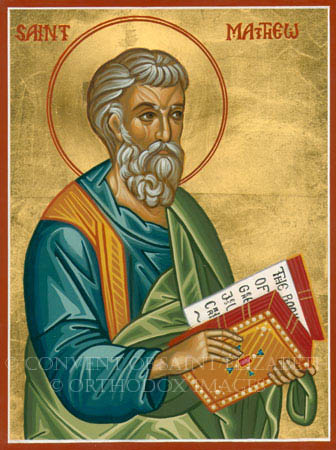
St. Matthew

Happy Holiness Day

Along with the anniversary of The Hobbit, September 21st is the feast day of my patron saint—St. Matthew, Apostle and Evangelist. Before his “coming to God moment”, Matthew worked for the Roman equivalent of the IRS. Hatred of paying government taxes is an innate principle built into humanity. Palestine 30 A.D. was no different. What courage and faith it must have taken Matthew to leave his luxurious, high paying government job?

Tax collectors were considered traitors to the Jewish people. They basically did the Roman government’s dirty work of extolling individuals for money. I always imaged how Matthew would fit in with Jesus’ motley crew of Apostles. Was he accepted right away? Did trust issues exist?

While such questions are purely speculative, but I find pondering the transition of Matthew from a hated tax collector to an evangelist helpful in my relationship with my patron saint. I too struggle to fit in at times, yet I am gifted with the ability to spread the Good News of Jesus Christ just like St. Matthew! September 21st is the beginning of my re-commitment to evangelize through my writing, family life, and volunteering at my parish. I hope to exhibit the same steadfast faith as Matthew did when Jesus said, “Follow me” (Luke 5:27).

follow me.gif

September of Sacraments

Together with my patron saint and favorite fantasy jubilees occurring on the same day, the month of September started as a transitional month for my family and I. My wife began a new job, our children started to get in the school routine, and changes galore occurred at work. Through the grace of God and ability in our hectic scheduling, and mostly due to my serious need for divine assistance I went to confession twice this month.

During my first confession, the priests gave me this amazing penance—pray the Prayer of Humility. Humility is the virtue that stands in opposition to the vice of pride. Pride is what made the Devil fall from his celestial pedestal as God’s favored angel. Pride leads me to be an inferior version of myself. Let us briefly ask God for the gift of true and beautiful humility:

O Jesus! meek and humble of heart, Hear me. From the desire of being esteemed, Deliver me, Jesus.

From the desire of being loved… From the desire of being extolled … From the desire of being honored … From the desire of being praised … From the desire of being preferred to others… From the desire of being consulted … From the desire of being approved … From the fear of being humiliated … From the fear of being despised… From the fear of suffering rebukes … From the fear of being calumniated … From the fear of being forgotten … From the fear of being ridiculed … From the fear of being wronged … From the fear of being suspected …

That others may be loved more than I, Jesus, grant me the grace to desire it.

That others may be esteemed more than I … That, in the opinion of the world, others may increase and I may decrease … That others may be chosen and I set aside … That others may be praised and I unnoticed … That others may be preferred to me in everything… That others may become holier than I, provided that I may become as holy as I should…

spiritual path

Be on the Lookout for Your Unexpected Journey

Unexpected journeys are difficult, but the joy attained through its travel is immeasurable. Jesus tells his disciples [and us], “Whoever wishes to come after me must deny himself, take up his cross, and follow me. For whoever wishes to save his life will lose it, but whoever loses his life for my sake will find it” (Matthew 16:24-25). God asks us each day: will you follow me?

Starting on September 21st, 2017, I said yes! I renewed my commitment to follow His lead. Will I continue on this path? I certainly hope so, only time will truly tell. I will close with the following exchange between the hobbit and wizard before the great journey:

Gandalf: I am looking for someone to share in an adventure that I am arranging, and it’s very difficult to find anyone.

Bilbo: I should think so—in these parts! We are plain quiet folk and have no use for adventures. Nasty disturbing uncomfortable things! Make you late for dinner! I can’t think what anybody sees in them …

Gandalf: You’ll have a tale or two to tell when you come back

Bilbo: You can promise that I’ll come back?”

Gandalf: No. And if you do, you will not be the same

Related Links:

3 Similarities I Share with my Namesake— Saint Matthew

Could J.R.R. Tolkien ever be canonized a saint?

An Unexpected Journey? The Case For The Canonization Of J.R.R. Tolkien

hobbit going on an adventure.gif

Thank you for sharing!

5 Epic Quotes to Prepare You for the Feast of Corpus Christi

CorpusChristi2-190x300.jpg

Along with the feast of the Most Holy Trinity, the celebration of the Most Precious Body and Blood of Jesus Christ (commonly called The Feast of Corpus Christi) is my favorite day in the Liturgical Year.

In preparation for this solemn celebration, I wish to share a few quotes from Catholic saints and/or Catholic faithful—the great English author J.R.R. Tolkien’s literature invites readers implicitly  to the Catholic faith. I hope the Catholic Church considered him for the canonization process.

Importance of the Eucharist

According to the Catechism of the Catholic Church paragraph 1324, “The Eucharist is “the source and summit of the Christian life.” The graces received from the Body, Blood, Soul, and Divinity of Jesus provide sustenance over the course of our pilgrim journey here on Earth. Nothing is more beautiful than the Eucharist. Receiving the Body of Christ transforms you.  The grace you receive in the sacrament is more powerful than any natural force on earth. Being in the light of the Son and receiving the true bread from heaven gives us a foretaste of the world to come!

source-summit-top-logo.jpg

Prepare to Celebrate Corpus Christi

Here are five powerful quotes that helped me draw further into wonder and adoration of the Blessed Sacrament of the Altar. While this is not an exhaustive list [NOT EVEN CLOSE!], I hope you find peace, joy, and strength when you reflect on these passages. May God Bless You and thank you for your continued support!


The only cure for sagging of fainting faith is Communion. Though always Itself, perfect and complete and inviolate, the Blessed Sacrament does not operate completely and once for all in any of us. Like the act of Faith it must be continuous and grow by exercise. Frequency is of the highest effect. Seven times a week is more nourishing than seven times at intervals.—J.R.R. Tolkien

“I throw myself at the foot of the Tabernacle like a dog at the foot of his Master.” —St. John Vianney

“If angels could be jealous of men, they would be so for one reason: Holy Communion.” —St. Maximilian Kolbe

“Receive Communion often, very often…there you have the sole remedy, if you want to be cured. Jesus has not put this attraction in your heart for nothing…” —St. Therese of Lisieux

“The Blessed Sacrament is indeed the stimulus for us all, for me as it should be for you, to forsake all worldly ambitions. Without the constant presence of our Divine Master upon the altar in my poor chapels, I never could have persevered casting my lot with the lepers of Molokai; the foreseen consequence of which begins now to appear on my skin, and is felt throughout the body. Holy Communion being the daily bread of a priest, I feel myself happy, well pleased, and resigned in the rather exceptional circumstances in which it has pleased Divine Providence to put me.” —Blessed Fr. Damien, Apostle of the Lepers

Related Links

The Body of Christ?

Feast of Corpus Christi

7 Reasons to Go to Eucharistic Adoration


Want to receive more content from The Simple Catholic?

Become an email subscriber. Enter your email address in the Subscribe to Blog Via Email box and hit the Subscribe button. It’s that easy! Soon you will be receiving authentic and unique Catholic content instantly in your inbox.


Thank you for sharing!

Why Suffering Makes You Stronger


Editor’s Note: This post was originally published on July 15, 2017.


Saint Ignatius of Loyola said, “If God sends you many sufferings; it is a sign that He has great plans for you and certainly wants to make you a saint.” As a Catholic I admire the witness of the saints. From a theological and cerebral perspective Ignatius makes sense, but to a person in the midst of trials his words just bring frustration. I believe I am in a period of consolation at this point in my spiritual journey. As a result, my reflection on the Spanish saint’s words may take on a different form now than during a low point in my life.

What I have found to be interesting during the past few months that I have been writing is that my more popular and greater trafficked posts relate to topics on my sufferings: from my anxiety over daily items to my great tribulations in life so far. Today I believe there are three specific reasons why writing about my own limitations appeal to others.

suffering.jpg

Suffering is Universal

J.R.R. Tolkien refers to the objective reality of widespread sorrow in his legendary work The Lord of the Rings. Below is a brief conversation between the soon-to-be heroic hobbit Frodo and the wizard Gandalf:

Frodo: I wish the Ring had never come to me. I wish none of this had happened.

Gandalf: So do all who live to see such times, but that is not for them to decide. All we have to decide is what to do with the time that is given to us.

Before I unpack the truth of Gandalf’s words, I will provide a little background on the nature of hobbits. According to both The Hobbit and The Lord of the Rings, hobbits are creatures that traditionally kept to themselves and stayed out of the political affairs of Middle-Earth. Hobbits enjoyed farming and living a quiet, peaceful existence.

Is that true of yourself?

Perhaps you are an individual that prefers solitary and silent times for reflection. If you are not like a hobbit that is certainly alright as well, but there may be times in your life when you may desire the craziness of life to slow down. I know that is definitely true for me. I am naturally a hobbit at heart.

Sudden Suffering

Life always seems to throw a wrench into my plan. Just like Frodo Baggins’ life was interrupted by the War of the Ring and Gandalf’s strong urging to bear the ring, so too I experience expectations thrust upon me that I am ill-equipped to face.

Suffering is universal. It is inevitable. Humans do not have to travel long or far in this world before suffering rears its ugliness! This is the primary reason why I believe my writing on my personal suffering appeals to others—because people suffer daily.

Sometimes quotes from a fictional character seem to ring truer or strike a chord closer than words I can provide myself. Frodo’s best friend Samwise Gamgee sums up humanity’s worry against suffering best, “It’s a dangerous business, Frodo, going out your door. You step onto the road, and if you don’t keep your feet, there’s no knowing where you might be swept off to.” We put ourselves into a paradox if we avoid suffering—we never step onto the road of life, but it is only stepping on the road that we are able to life. Avoidance of suffering is not fully living!

honesty is best policy.png


Honesty is the best policy

To continue on the fact that suffering is universal, I think that by truthfully acknowledging my limitations and sinful nature I open myself up to let others into my life. My favorite authors include C.S. Lewis, Francis de Sales, and G.K. Chesterton [to name a few]. Each writer admits their failings. I experience Lewis, de Sales, and Chesterton’s humanity through their writing.

In a similar fashion, I have noticed that my own personal favorite and best works are done when I am most honest—not when I utilize the best vocabulary or sentence structure. Half of the times, I am not even aware of what I am going to write about on a particular day or even how I am going to finish a post. Words flow from my mind more easily when I draw upon my experiences of suffering and strife. I cannot explain why that is the case. I can only say that my honesty about my past suffering acts as a cerebral embolectomy for my occasional writer’s block!

the_fellowship_of_the_ring___orange__dirty_by_chipsess0r-d744eef.jpg


Fellowship Leads to Fitness in Battle

My battle against personal vices [anger, greed, impatience, pride, etc] is daunting. What makes my encounter with these evils more bearable is community. Through the fellowship of my family, faith community in the Catholic Church, and my readership I am soothed. I am reminded again of Tolkien’s trilogy during my personal struggles.

In the third book The Return of the King, weariness weighs down on Frodo as he ascends Mount Doom in his attempt to destroy Sauron’s Ring. Listen to the hero’s lament when the evil of the ring tempts him:

Frodo: I can’t recall the taste of food, nor the sound of water, nor the touch of grass. I’m naked in the dark. There’s nothing–no veil between me and the wheel of fire. I can see him with my waking eyes.

Sam: Then let us be rid of it, once and for all. I can’t carry the ring for you, but I can carry you! Come on!

The main hero in the story experiences weakness and laments to the last individual from the original Fellowship formed at the beginning of the journey— fellow hobbit Samwise. Here a fellowship becomes incarnate in Sam. He is not the strongest, smartest, or most clever hero, but he is present in Frodo’s greatest time of need. It is only through Frodo’s donning of the ‘armor of weakness’ [making himself vulnerable and feeble to his friend] that true fellowship happens.

Instead of becoming weaker when I show my limitations and failure the fellowship around me [wife, family, faith, and friends] is galvanized and I am made stronger. Together a fellowship stands the test of temptation and vice.

Related Links

Catholic Camaraderie—Unity in Suffering

Suffering and Strength

St. Paul explains the meaning of suffering


Become an email subscriber (enter your email address in the Subscribe to Blog Via Email box and hit the Subscribe button. It’s that easy! Soon you will be receiving Catholic content in your inbox.

May God give you strength to endure your current suffering. 🙏


Thank you for sharing!