An Unexpected Journey- How September 21st, 2017 Became the New Start to My Spiritual Life

hobbit gif.gif


Editor’s Notes: Originally published September 22nd, 2017


Over the past few weeks, life has been throwing stress-filled curveballs at me. Reeling from anxiety, anger, and frustration, I recently went to the spiritual medicine box—Confession—to gain sacramental graces to help me grow in patience and perspective. I experienced a true transformation in my life this week in the days following my reconciliation with God, the Church, and my fellow man. September 21st, 2017 became a new launching point for my spiritual journey. Excited for this re-start on my path toward Christian holiness, I will provide a few reasons why this date holds a special place in my heart.

The hobbit book

Anniversary of the Publication of The Hobbit

Eighty years ago, on September 21st, 1937, The Hobbit—an essential item on any fantasy fan’s bookshelf—was published. Eight decades later the tale of J.R.R. Tolkien still instills wonder in its readers.

Regrettably, I did not explore Middle Earth until my mid-20s. Over the past five years, I have read The Hobbit twice and The Lord of the Rings trilogy once.

A true literary treasure is measured through its ability to stand the test of time. Nearly a century later, I would say that Tolkien’s work passes with flying colors. Characters within the story seem to speak directly to me. For instance, the dwarf Thorin tells Bilbo, “There is more in you of good than you know, child of the kindly West. Some courage and some wisdom, blended in measure. If more of us valued food and cheer and song above hoarded gold, it would be a merrier world.” How easy is it for us to lose memory of the importance things in life? I forget fairly quickly. Tolkien reminds me to look for the hidden joys in my life. Perhaps, an unexpected journey is in store for me starting September 21st, 2017.
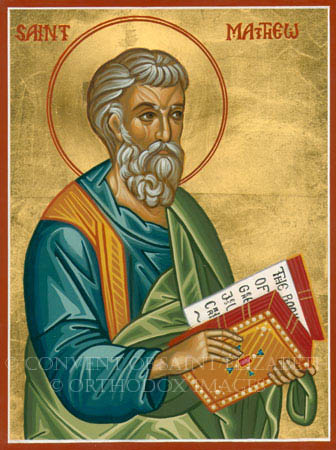
St. Matthew

Happy Holiness Day

Along with the anniversary of The Hobbit, September 21st is the feast day of my patron saint—St. Matthew, Apostle and Evangelist. Before his “coming to God moment”, Matthew worked for the Roman equivalent of the IRS. Hatred of paying government taxes is an innate principle built into humanity. Palestine 30 A.D. was no different. What courage and faith it must have taken Matthew to leave his luxurious, high paying government job?

Tax collectors were considered traitors to the Jewish people. They basically did the Roman government’s dirty work of extolling individuals for money. I always imaged how Matthew would fit in with Jesus’ motley crew of Apostles. Was he accepted right away? Did trust issues exist?

While such questions are purely speculative, but I find pondering the transition of Matthew from a hated tax collector to an evangelist helpful in my relationship with my patron saint. I too struggle to fit in at times, yet I am gifted with the ability to spread the Good News of Jesus Christ just like St. Matthew! September 21st is the beginning of my re-commitment to evangelize through my writing, family life, and volunteering at my parish. I hope to exhibit the same steadfast faith as Matthew did when Jesus said, “Follow me” (Luke 5:27).

follow me.gif

September of Sacraments

Together with my patron saint and favorite fantasy jubilees occurring on the same day, the month of September started as a transitional month for my family and I. My wife began a new job, our children started to get in the school routine, and changes galore occurred at work. Through the grace of God and ability in our hectic scheduling, and mostly due to my serious need for divine assistance I went to confession twice this month.

During my first confession, the priests gave me this amazing penance—pray the Prayer of Humility. Humility is the virtue that stands in opposition to the vice of pride. Pride is what made the Devil fall from his celestial pedestal as God’s favored angel. Pride leads me to be an inferior version of myself. Let us briefly ask God for the gift of true and beautiful humility:

O Jesus! meek and humble of heart, Hear me. From the desire of being esteemed, Deliver me, Jesus.

From the desire of being loved… From the desire of being extolled … From the desire of being honored … From the desire of being praised … From the desire of being preferred to others… From the desire of being consulted … From the desire of being approved … From the fear of being humiliated … From the fear of being despised… From the fear of suffering rebukes … From the fear of being calumniated … From the fear of being forgotten … From the fear of being ridiculed … From the fear of being wronged … From the fear of being suspected …

That others may be loved more than I, Jesus, grant me the grace to desire it.

That others may be esteemed more than I … That, in the opinion of the world, others may increase and I may decrease … That others may be chosen and I set aside … That others may be praised and I unnoticed … That others may be preferred to me in everything… That others may become holier than I, provided that I may become as holy as I should…

spiritual path

Be on the Lookout for Your Unexpected Journey

Unexpected journeys are difficult, but the joy attained through its travel is immeasurable. Jesus tells his disciples [and us], “Whoever wishes to come after me must deny himself, take up his cross, and follow me. For whoever wishes to save his life will lose it, but whoever loses his life for my sake will find it” (Matthew 16:24-25). God asks us each day: will you follow me?

Starting on September 21st, 2017, I said yes! I renewed my commitment to follow His lead. Will I continue on this path? I certainly hope so, only time will truly tell. I will close with the following exchange between the hobbit and wizard before the great journey:

Gandalf: I am looking for someone to share in an adventure that I am arranging, and it’s very difficult to find anyone.

Bilbo: I should think so—in these parts! We are plain quiet folk and have no use for adventures. Nasty disturbing uncomfortable things! Make you late for dinner! I can’t think what anybody sees in them …

Gandalf: You’ll have a tale or two to tell when you come back

Bilbo: You can promise that I’ll come back?”

Gandalf: No. And if you do, you will not be the same

Related Links:

3 Similarities I Share with my Namesake— Saint Matthew

Could J.R.R. Tolkien ever be canonized a saint?

An Unexpected Journey? The Case For The Canonization Of J.R.R. Tolkien

hobbit going on an adventure.gif

Thank you for sharing!

3 Lessons from St. Therese of Liseux—Changing Lives One Day at a Time


Editor’s Note: This post originally published on July 20, 2018.


Saint Therese of Liseux once stated, “Our Lord does not so much look at the greatness of our actions, or even at their difficulty, as at the love with which we do them.” Part of the universal appeal of the Little Flower was her simplicity and humility when approaching the greatness of God.

As a classic over thinker and a perfectionist, I tend to overanalyze sanctity. Making checklists or reminders on my phone, I try to cram a bunch of spiritual activities into a week all the while juggling a healthy work, life, and exercise routine! I am exhausted simply thinking about scheduling confession in on a Saturday around my three children’s naptime and giving my wife time to go to the medicine box as well.

At work the stress continued. The constant barrage of complaints, concerns, and questions wear down a person. I try to give myself a few seconds rest between the hustle and bustle. St. Therese taught me three important lessons this week.


Saint Therese of Liseux

Start Small

The French saint wisely stated, “Miss no single opportunity of making some small sacrifice, here by a smiling look, there by a kindly word; always doing the smallest right and doing it all for love.” I have previously written about the importance of small incremental steps to gain progress; however, it is always good to remind ourselves that great things start with doing the little things well.

Children learning to ride a bicycle do not normally go from training wheels to mountain/trail cycling overnight. Bumps, bruises, tears, and frustrations abound over the course of time when learning to ride a bike. The same is true in our pilgrim journey towards holiness. Missed opportunities of smiling at an annoying co-worker or your trouble neighbor does not help our advancement in our sojourn of sanctity. St. Mother Teresa matter-of-factly said, “You have to be holy where you are – wherever God has put you.”  Following in the footsteps of both Therese/Teresa’s I hope to remember daily to start little—with baby steps—as a I grow in holiness.

Fueled by the Fire of Love

According to Genesis 3, the curse place upon Adam [and later all mankind] was work being toilsome and difficult. In fact, the day of the Fall may have well been history’s first Monday! All joking aside, we normally dread work because it takes away of play—an activity of something which we enjoy and love doing. St. Josemaria Escriva declared, “Either we learn to find the Lord in the ordinary everyday life or else we shall never find him.”

fire of love

Very much in keeping with his spirituality, and likely a major influence for the Founder of Opus Dei, St. Therese reminds us that work need not be toilsome—as long as daily work is fueled by love. Watered by love—of God and neighbor—work blossoms into a sweet activity that paradoxically involves suffering but bring joy as well! “I understood that love comprises all vocations – that love is everything, and because it is eternal, embraces all times and places,” the sainted French nun declared.

Part of a Whole

The final piece wisdom the Little Flower of Lisieux imparted to me this week was the importance of seeing myself as a part of a larger whole. Now this is not to reduce myself to a small wheel in the cog of Catholicism—such as view is entirely utilitarian and reduces our relationship to other human beings as purely functional/technical.

According to the Catechism of the Catholic Church paragraph 952, when speaking about the communion of saints, “Everything the true Christian has is to be regarded as a good possessed in common with everyone else. All Christians should be ready and eager to come to the help of the needy. . . and of their neighbors in want.”487 A Christian is a steward of the Lord’s goods.” As a husband and father, I learned my will must be subordinated for the good of the other members of my family.

Love your neighbor

Easily declared from my theological armchair, I struggle mightily in the midst of family life and the bustle of raising children. Here is where the example and spiritual maturity of St. Therese again teaches me. On the subject of being a saint, Therese stated, “I realized that to become a saint one must suffer a great deal, always seek what is best, and forget oneself.”

Depend on God

The youngest of nine siblings Therese learned quickly in life that she could not always be the center of attention—although she did admit in her Diary of a Soul that her selfishness pervaded her very earliest of years. The Little Flower’s constant message in her writings about her [and our] need to have a complete dependency on God our Heavenly Father helped shift my selfish mindset toward others and the Ultimate Other.

Start small, easy your daily struggle with the fuel of love, and remember you are part of a larger whole—members of the human race. These three lessons the young, but wise French saint taught me this week.

Related Links

5 Reasons Why October is the Holiest Time of the Year

St. Therese of Lisieux is a Spiritual Powerhouse

Live Like St. Thérèse of Lisieux

Thank you for sharing!

Say YES to the NO—Practicing Self-Denial

The Italian mystic St. Paul of the Cross boldly said, “Be as eager to break your own will as the thirsty stag is to drink of the refreshing waters.” I emphasized the phrase break your own will as that imaginary stood out as quite audacious. To break the will seems such a violent thing to do to yourself.

After researching a bit on this saint, I learned that Paul was the founder of the Passionists a religious order dedicated to a penitential life in solitude and poverty. Since Paul of the Cross lived in isolation from the world do his words hold any meaning for a regular, ‘normal’ people who hold down jobs, have a family? Should not “super-holiness” be reserved for priests and nuns?

dwight false gif.gif

fulton sheen personal holiness meme.png


You are Called to Holiness

According to the Catechism of the Catholic Church paragraph 2013, “All Christians in any state or walk of life are called to the fullness of Christian life and to the perfection of charity.”65 All are called to holiness: “Be perfect, as your heavenly Father is perfect.”

We are coming up on the perfect season to increase our holiness— Lent! The Lenten season is modeled after Jesus’ 40-day time in the wilderness. Because Jesus is God, he was able to stave off the allures of the Devil. His witness showed that both praying and fasting disable the weaponry of the Evil One. The practice of self-denial is absolutely essential in growing in virtue! Saying YES to God through prayer allows us to say NO to those unhealthy pleasures of the world—through the practice of fasting.

fasting meme.jpg


Say NO to Sin

struggle mightily with the pressures of the world, and those self-imposed. Anger, resentment, and impatience come as a result of succumbing to the things of this world. Self-reflection and renewing a practice for saying YES to pray helps begin a habit of saying NO to: impatience, pride, greed, envy, power-control, etc.

Saint Francis de Sales affirms the message of Paul of the Cross, the Catechism and Christ by stating, “The more one mortifies his natural inclinations, the more he renders himself capable of receiving divine inspirations and of progressing in virtue.” Be fast to practice fasting. If you struggle at first remember to say YES to God (pray!) in order to say NO to yourself.

fulton sheen personal holiness meme.png

Thank you for sharing!

A Holy Kaleidoscope—The Diversity Of The Saints In Light Of Christ

Have you ever received gifts or trinkets growing up that you continue to keep for sentimental or nostalgic value? Something a family member or a friend gave you on a birthday or for a special event that remains on prominent display in your home?

Prism

I received a prism on my 8th birthday. A simple but an intriguing item. I kept it on my bookshelf for many years. Unfortunately, I lost the prism.  I still reflect (no pun intended) on the awesome light tricks: bending rays of light and creating miniature rainbows.  The splendid spectrum-forming crystal helped in forming simple and joyful memories with my siblings. Since lacking a physical prism, I still use a metaphorical prism as a perfect analogy for explaining how diversity (of light) can be reconciled into a focus of unity.

The word diversity tends to invoke sudden reactions from people. Perhaps it is due to a hostile political environment or maybe it is because various entertainment sources poke fun at striving for differences of thought (refer to The Office Season 1 Episode 3: “Diversity Day”). Even within my own workplace I hear co-workers scoff or grumble at the idea of recognizing differences in opinion, culture, thought, or belief. Oftentimes, failure to identify the good that people’s differences can bring for the greater good lead to hostile environments, bullying, fractured relationships, and promote self-centered tendencies.

Communion of saints

Rainbow of Holiness

Focusing on the ugliness of the differences in the trees leads to us missing out on the beauty of the forest when viewed all together—in unity. As a person who struggles mightily with change and a fervent desire to maintain consistency throughout the day, week, and year, I oftentimes fail to see how differences can promote unity.

Jesus in his Sermon on the Mount, urges his followers, “You are the light of the world” (Matt. 5:14). Prisms separate light into various hues. Analogously, the Holy Spirit bestows individuals various gifts (hues) of charisms. These gifts help spread the light of the Gospel. Only unified through the light of Christ may the saints provide various ways to communicate the Gospel. Saint John Paul the Great said, “Unity not only embraces diversity, but is verified in diversity.”

The Catholic Church teaches various paths to holiness exist. According to the Second Vatican Council’s Dogmatic Constitution on the Church Lumen Gentium,

“All the faithful of Christ of whatever rank or status are called to the fullness of the Christian Life and the perfection of charity; by this holiness as such a more human manner of living is promoted in this earthly society” (no. 40).

God calls everyone to holiness.

Ordained Saints

Holy Orders

I will not spend too much time on saints who received the sacrament of Holy Orders as the more famous saints that come to mind were priests, deacons, or bishops. According the Catechism of the Catholic Church,

“Since the beginning, the ordained ministry has been conferred and exercised in three degrees: that of bishops, that of presbyters, and that of deacons. The ministries conferred by ordination are irreplaceable for the organic structure of the Church: without the bishop, presbyters, and deacons, one cannot speak of the Church” (1593).

Saints that immediately come to mind who received the sacrament of Holy Orders include the following (not even close to an exhaustive list):

  • Peter
  • Augustine
  • Athanasius
  • Gregory the Great
  • Stephen
  • Pope John Paul II
  • Francis of Assisi
  • Francis de Sales

Married Saints

Saints Louis and Zelie Martin

The vast majority of the Catholic faithful consists of married couples and their families. However, when I was researching for this article I could not think of any married saint immediately off the top of my head. Perhaps it is because marriage is more commonplace than Holy Order. I think the diversity between a man and woman in the Mystery of the sacrament of Matrimony has been lost in our culture.

Not everything in marriage needed to be reduced to sameness between the spouses. If that happens a little bit of the Mystery may disappear. Marriage involves learning about your spouse. Love desires sacrifice. It’s not about conformity or coercion. I can’t expect my wife to be exactly the same as me. The sacramental grace received from the Holy Spirit helps us grow in holiness.

Diversity leads to unity.

Here’s a list of some married saints:

  • Louis and Zelie Martin (more famously known as the parents of St. Therese of Lisieux)
  • Monica (mother of St. Augustine)
  • Elizabeth Ann Seton
  • Joachim and Anne (parents of the Blessed Virgin Mary)

Religious Saints

Saint Teresa of Avila

Individuals not called to receive the sacrament of Holy Orders or Matrimony, often go on to live out the vocation of the religious life. The Catechism states the following about this vocation,

“Religious life derives from the mystery of the Church. It is a gift she has received from her Lord, a gift she offers as a stable way of life to the faithful called by God to profess the counsels. Thus, the Church can both show forth Christ and acknowledge herself to be the Savior’s bride. Religious life in its various forms is called to signify the very charity of God in the language of our time” (926).

Saints who lived out this lifestyle provides an impetus to the Church in times of slow growth or decline. Among the saints who lived out their religious vocations include:

  • Benedict of Nursia
  • Teresa of Avila
  • Mother Teresa of Calcutta
  • Maria Faustina
  • Therese of Lisieux

Consecrated Life

Catherine of Siena

The fourth and final vocational path to holiness is the consecrated life. Such individuals do not receive the Sacrament of Holy Orders, Matrimony, nor life in a religious community. This vocation often gets misinterpreted as miscellaneous catch-all category for individuals either indecisive or uncommitted to the other ways to holiness.  But the consecrated life is a valid and essential vocation needed in the Church. The Catechism  reads highly of this vocation,

“The state of life which is constituted by the profession of the evangelical counsels, while not entering into the hierarchical structure of the Church, belongs undeniably to her life and holiness” (914).

This vocation in particular affords individuals a certain freedom, not enjoyed by the other vocational paths. People living out the chaste and consecrated life share their unique gifts with the world.

Saints who lived out this fourth path to holiness include:

  • Agatha
  • Lucy
  • Agnes
  • Catherine of Siena
  • Joan of Arc

Diversity (and Unity) of Love

Light of the world

According to Lumen Gentium,

“For just as in one body we have many members, yet all the members have not the same function, so we, the many, are one body in Christ, but severally members one of another” (32).

While the ever relatable analogy of the Body and its individual parts testify to the truth of the unity of the Catholic Church in spite of its diverse members, I find that the analogy of the light and the color-spectrum also provides an interesting view on this seeming tension between unity and diversity. Along with my gift of a prism, I enjoyed looking at kaleidoscopes. The beauty would be lost without having light to shed brilliance on the kaleidoscope. In a similar way, the uniqueness, diversity, and individual excellence of the saints would all be in vain unless viewed through the prism of Jesus Christ.

Related Links

Communion of Saints: The doctrine expressed in the Apostles’ Creed

5 Reasons Why October is the Holiest Time of the Year

The Deeper Meaning of the Communion of Saints

The Beginner’s Guide to Catholic Saints


Thank you for sharing!

A Good Friday Reflection: Fixing Our Gaze on Golgotha

Jesus at Golgatha


Editor’s Note: This post was originally published on April 19, 2019.


A Prayer Before the Cross

Lord Jesus Christ, I petition you as your most unworthy servant and adopted child through the waters of Baptism to hear my petitions. Please soothe the anxiety in my heart, mind, and soul over the pressures, toils, and attacks of despair the Enemy sends my way. Self-doubt and self-loathing pervades me mind throughout today.

Saint  Catherine of Sienna wrote, “Every great burden becomes light beneath this most holy yoke of the sweet will of God.” May I receive the graces from the Holy Spirit to love myself and confidently seek your Will, not for my sake but as in loving myself I make a worthy offering to you Most Holy God.

My sins wound me. Damage my relationship with myself, my neighbors, and ultimately You Most Holy Trinity. I ask the Blessed Virgin Mary and the saints in Heaven to help re-orient my gaze to the Cross of Jesus—crucified on Golgotha.

Focus on God

May Mary Intercede for Us

I recall the words from a homily by my parish priest who declared, “It is through the atmosphere of Mary that we truly are able to receive the light of the Son.” According to John 19:26-27, “When Jesus saw his mother and the disciple there whom he loved, he said to his mother, ‘Woman, behold, your son.’ 27 Then he said to the disciple, ‘Behold, your mother.’ And from that hour the disciple took her into his home.”

At the foot of the Cross, Jesus entrusted his beloved disciple [and all humanity] to his mother. More important, Jesus gifts us the blessing of the Blessed Virgin Mary as well.

Mary at Foot of Cross

Failures, trials, and doubts will surround us throughout life. Uniting ourselves to Christ’s suffering in Calvary brings joys and peace in the struggle. Remembering that we are all in this pilgrim journey, towards holiness, together helps sustain me in my downtrodden times.

Related Links

Where is Golgotha? Where did Jesus die? Church of Holy Sepulchre vs. the Garden Tomb

Why Catholics Must Have Bible A.D.D. Part 4- Jesus as the New Passover Lamb

Why Maundy Thursday is an Important Part of Holy Week

Thank you for sharing!

10 Reasons Why Catholics Should Always be Thankful

bill murraygiphy.gif


Editor’s Note: This post was originally published on November 26, 2017.


G.K. Chesterton stated in Christmas and Salesmanship, “Gratitude, being nearly the greatest of human duties, is also nearly the most difficult.” As a father I know all too well how difficult it is sometimes for my children to express gratitude to me. On the other hand, as a husband I struggle to tell my wife how thankful for all that she does. Not only do I need to improve on my attitude of gratitude within my marriage,  I need to focus on having a thankful mindset in my spiritual life and relationship with God. In celebration of the Thanksgiving holiday, I came on my top ten reasons for why I am thankful for Catholicism!

eucharist 2

Eucharist

The Bread of Life Discourse in John 6 has Jesus preaching the most profound truth in the history of the universe. Jesus said, I am the living bread that came down from heaven; whoever eats this bread will live forever; and the bread that I will give is my flesh for the life of the world” (John 6:51). The Catechism of the Catechism Church calls the Eucharist the “source and summit of the Christian life” (CCC 1324). Every Sunday I experience the miracle of being able to receive the body, blood, soul, and divinity of Jesus Christ!

holy trinity.jpg

Holy Trinity

God is love. Love entails relationship. The doctrine of the Holy Trinity is the Mystery that God is a Communion of Three Persons—Father, Son, and Holy Spirit. I am grateful for the revelation of this truth. I am able to ponder the depth of its truth without it growing stale, it always remains fresh and profound!

Incarnation

The most solemn moment of the Nicene Creed occurs when we profess: “For us men and for our salvation he came down from heaven; by the power of the Holy Spirit, he became incarnate of the Virgin Mary, and was made man.” At this point, we bow to recognize the amazing fact that God became a mere human. St. Athanasius had this to say about the Incarnation, “God became man that man might become God” (On the Incarnation). I am thankful that God sent his only Son-Jesus Christ—to become a bridge for humanity to access God.

confession first aid.jpg

Confession

I have experienced real, tangible, and concrete healing when I receive God’s healing grace’s in the Sacrament of Reconciliation. Through frequent reception of Penance, I have been able to overcome sins that dominated me in my youth. I have also been able to recognize sins that hid in the background previously. As a result, Confession provides me with graces to root out sinful tendencies and to grow in holiness.

divine mercy trust in you.jpg

Divine Mercy

While I experience Divine Mercy in the Sacrament of Confession, I want to treat this topic as a separate point. I used to view God as a wrathful Judge. My scrupulosity leads to a judgmental mentality—that I struggle with still today. However, through the intercession of the Divine Mercy saints of the 20th century such as St. Maria Faustina, John Paul II, Maximilian Koble, and Mother Teresa my awareness that God is a Merciful and Just Judge has increased!

 Mary

My relationship with our Blessed Mother has improved over this past year. In celebration of the centenary anniversary of the Apparitions at Fatima, my wife and I consecrated ourselves to Jesus through St. Louis de Montfort stated, “[Mary] is the safest, easiest, shortest and most perfect way of approaching Jesus and will surrender themselves to her, body and soul, without reserve in order to belong entirely to Jesus” (True Devotion to Mary). I learned that Mary is the greatest witness and advocate for God. Her desire is to lead ll her children to Jesus Christ.

 Saints

Along with Mary, the saints in Heaven provide a model for me to follow to help me grow in holiness. Reading about the lives of my favorite saints [St. Athanasius, John Paul II, St. Amelia, St. Bernadette, St. Pius IX, St. Maria Faustina, and St. Maximilian Koble—to name a few] helps provide concrete examples of what holiness looks like and how I am able to emulate their trust in God in my own life.

 Hope

I am thankful for the hope that the Catholic Church teaches and provides me daily. Attending Sunday Mass, going to Eucharistic Adoration, meeting with my monthly Catholic men’s group, and teaching Religious Education at my parish are ways that I receive [and pass on] hope. According to the Catechism of the Catholic Church paragraph 1843, “By hope we desire, and with steadfast trust await from God, eternal life and the graces to merit it.”

catholic church.jpg

Sacred Tradition

I am a history buff. In fact, I earned my undergraduate degree in history. The Catholic Church is a storehouse and guardian of 2,000+ years of history and tradition. While lesser important traditions pass away and give way to more appropriate devotional practices that fits the needs of the faithful, Jesus Christ knew that stability and consistency of truth is essential in mankind’s relationship with God.

The Catechism tells us in paragraph number 96-97,

What Christ entrusted to the apostles, they in turn handed on by their preaching and writing, under the inspiration of the Holy Spirit, to all generations, until Christ returns in glory. ‘Sacred Tradition and Sacred Scripture make up a single sacred deposit of the Word of God’ (DV 10) in which, as in a mirror, the pilgrim Church contemplates God, the source of all her riches.

I am thankful that Jesus instituted the priesthood and office of the papacy to have truth passed on through the ages.

Beauty

The final fact about Catholicism in my top ten list that I am grateful for is the beauty I experience. Catholic cathedrals and basilicas are places where I have experienced beauty in an ineffable way. During the celebration of the Liturgy, I experience the beauty of God in both song and sight. The icons in my local church allow my prayers to be better united to God. I am pointed toward higher realities when I meditate with the aid of sacred song and holy images.

icon of jesus.jpg


Lord, we thank you
for the goodness of our people
and for the spirit of justice
that fills this nation.
We thank you for the beauty and fullness of the
land and the challenge of the cities.

We thank you for our work and our rest,
for one another, and for our homes.
We thank you, Lord:
accept our thanksgiving on this day.
We pray and give thanks through Jesus Christ our Lord.

R: Amen.

Related Links

Catholics, Be Thankful Always and Everywhere

Why I’m Thankful To Be Catholic

Announcing 10 Catholic Role Models to be Thankful for!

Thank you for sharing!

3 Reasons Why Saint Joseph is the Best Role Model for Men

ron swanson be a man

On March 19 the Catholic Church celebrates the feast day of Saint Joseph—foster father of Jesus. According to Richard E. Vatz, professor at Towson University in a Washington Times article titled, The social costs of fatherlessness, “there is no root cause more consequential in producing permanent violence, poverty and related life dissatisfaction issues than fatherlessness.”

Saint Joseph provides the ideal for what it means to be a kind and loving father and man. More than ever this world needs strong men to be role models for their families and communities.

The foster father of Jesus’s example of silence, humility, and patience will equip men with the tools necessary to foster meaningful and lasting relationships.

Silence leads to sanctity

Guess how many words of St. Joseph did the Evangelists record in the Gospels? If you guessed a whopping ZERO than you are correct my friend! Though included in the key infancy and adolescent scenes of Jesus’ life the foster father of our Lord said nothing!

silence of St Joseph

The old adage “actions speaks louder than words” applies more directly to St. Joseph than arguably any other person in history– as we can only analyze his actions. Cardinal Robert Sarah in The Power of Silence: Against the Dictatorship of Noise plainly stated, “Man must make a choice: God or nothing, silence or noise.” Using Sarah’s logic Joseph not only clearly, but overwhelmingly choose God!

Joseph’s ability to heed the Angel’s message to flee the wrath of King Herod demonstrates a complete trust and dependence on God. The noise of life yanks me in different directions– all away from God. Looking to the silent saint as a role model helps to remind me of the importance of asking the Lord for help.

Humility overcomes Hubris

humility over pride

Hearing that you must play “second fiddle” naturally causes humans to react in various manners. Being the “B team” certainly just not connote a positive image in sports, politics, and work. Some people downplay the role of a foster, or step-parent. “I am not the real, or official dad” is a mantra that may go through a stepdad’s head—especially on hearing the news that children are a package deal with his so-to-be spouse.

The movie Stepdads comically portrays the real life challenges men have to face in modern mixed family units. Both my wife and I thoroughly enjoyed that movie, but not merely because of the comedy. Rather, its message rang true that mere biology does not suffice for parenthood, let alone fatherhood. Love is the hallmark of fatherhood.

True love involves the virtue of humility. According to Peter Kreeft, “Humility is not an exaggeratedly low opinion of yourself. Humility is self-forgetfulness.” St. Joseph accepted the responsibility of raising Jesus Christ as his own even though he and Mary never had sexual relations.

As a just man, Joseph obeyed God’s will and married Mary. St. Pope Paul VI in his homily for the Feast of St. Joseph in 1969 used the word humble six times in referring to the foster father of Jesus. More specifically, the recent canonized pontiff wrote, “Saint Joseph is the model of those humble ones that Christianity raises to great destinies, and he is the proof that in order to be good and genuine followers of Christ there is no need of ‘great things’; it is enough to have the common, simple, human virtues, but they need to be true and authentic (Emphasis added mine).” St. Joseph’s simple, humble, and hidden life act as a good model for fathers, and men in general, that avoiding the drama of sin is possible and worthwhile!

Model for Workers

Russian novelist Leo Tolstoy remarked, “The two most powerful warriors are patience and time.” Although St. Joseph’s lifespan may be up for debate, his levels of patience certainly could not be argued. Being a carpenter by trade, I am most confident that Joseph was quite patient. I can barely do a house project without cursing let alone craft with wood.

Men typically associate themselves with the work that they do. “Where do you work?” is almost always the first question I am asked (and that one that I ask) when meeting a new guy either at the parish, neighborhood, or at work outings. St. Pope John Paul II articulates the value of work best in his Apostolic Exhortation Redemptoris Custos,

If the Family of Nazareth is an example and model for human families, in the order of salvation and holiness, so too, by analogy, is Jesus’ work at the side of Joseph the carpenter. In our own day, the Church has emphasized this by instituting the liturgical memorial of St. Joseph the Worker on May 1. Human work, and especially manual labor, receive special prominence in the Gospel. Along with the humanity of the Son of God, work too has been taken up in the mystery of the Incarnation, and has also been redeemed in a special way. At the workbench where he plied his trade together with Jesus, Joseph brought human work closer to the mystery of the Redemption (no 22, Emphasis added mine).

joseph the worker

Conclusion

Due to Original Sin, humanity suffered (still suffers) a fractured relationship with God. The Mystery of the Incarnation involved God becoming man in the Person of Jesus Christ. Divine Love selected Joseph of Nazareth to be the legal and foster father of Jesus Christ and protector of Mary. St. Paul VI declared in his Homily on Saint Joseph, “Because of that function which he [Joseph] performed in regard to Christ during his childhood and youth, he has been declared Patron or Protector of the Church, which continues Christ’s image and mission in time and reflects them in history”.

May all men reflect upon the silent, humble, and diligent example of St. Joseph the Worker, and Foster-father of Jesus and ask the Holy Spirit to be graced with opportunities to be holier versions of ourselves!

Related Links

The Prayer To Saint Joseph

3 Ways the Holy Family will Help Your Family


If you enjoyed learning about Saint Joseph and want to receive similar content consider becoming an email subscriber. Enter your email address in the Subscribe to Blog Via Email box and hit the Subscribe button. It’s that easy! Soon you will be receiving informative and faithful Catholic content in your inbox.

Thank you for sharing!