3 Reasons Catholics Should Have a Saint Statue at Home

Catholic saint statues


What is the deal with Catholics and their statues? Are they committing idol worship? Is this not against the 1st Commandment? These are common objections Protestants have against the owning of holy images. This article will be focused on showing three reasons why possessing sacred art and statues is something all Catholics should do and how they help build our faith.

Saint Statues Deepen Our Belief in the Incarnation

Having a statue of a saint in your home deepens your belief in God. According to the Catechism of the Catholic Church paragraph 2141, “The veneration of sacred images is based on the mystery of the Incarnation of the Word of God. It is not contrary to the first commandment.”

Often, we forget that Jesus is 100% human along with being 100% God. His miracle stories in the Gospels and Resurrection sometimes overshadow the fact that Jesus Christ lived a human life—he slept, ate, and experienced emotion.

Incarnation


Possessing saint statues anchors our faith in the Incarnation because God became fully human. Holy statues provoke a certain tangibility, rawness, and realness of humanity.  I experience this when I enter a Catholic Church with sacred art (icons and statues) of Jesus and the saints. If you’ve ever entered a church without such art you experience a dullness or staleness. Should not the same be true for your home?

St. John Paul II wrote in his Apostolic Exhortation Familaris Consortio, “the little domestic Church, like the greater Church, needs to be constantly and intensely evangelized: hence its duty regarding permanent education in the faith” Keeping saint statues around your home will help elicit questions from your children, or visitors, about important figures in Catholic Church history.

Guides to God

Saint Statues

A second key reason to have a saint statue in your home is tied closely with the first—saints help point you to Christ. The Catechism speaks of saints in paragraph 957, “Exactly as Christian communion among our fellow pilgrims brings us closer to Christ, so our communion with the saints joins us to Christ, from whom as from its fountain and head issues all grace, and the life of the People of God itself.”

Proper veneration of the saints leads us towards Christ, never away from Him. A statue of the Blessed Virgin Mary located in your dining or living room and other saints around your home will only aid as a reminder—you are not alone in this journey toward Heaven.
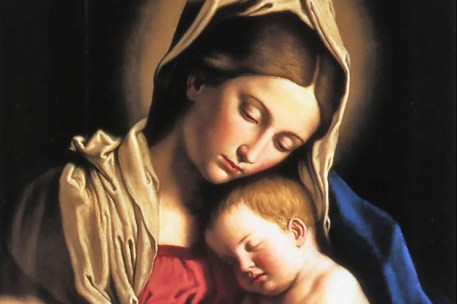
Mary and Jesus


Growing up, our statue of Mary in our dining room helped to remind me that she is our Mother and helps us get to her Son—Jesus. This reminder helped keep my eyes on Christ, especially during my teen years!

Family, Friends, Fellowship

Along with deepening your faith in the Mystery of the Incarnation and pointing you towards Christ, keeping holy statues will help foster fellowship. Traditionally, Catholics name children after a saint. The reason for this is because we honor and look to these holy men and women for guidance.


Saint Teresa of Avila quote

Among the highlights of marriage my wife and I anticipated, during our engagement was the naming of our children. All members of the family are called to holiness. We selected saint names whose lives exemplified heroic virtue and testimony of truth: Bernadette, Teresa of Avila, Matthew, Catherine of Siena, Maria Faustina, and Fabian just to name a few!

A simple way to grow in fellowship with your family’s patron saints is to celebrate their feast day. Owning a statue of a saint unique to your family will provide a more tangible connection to your holy friend. Gazing at the face of your patron saint, in the living room or bedroom, will help remind you daily of their holy life and strong love of God. Seeing the image of Mary Queen of Peace in my living room brings comfort during a stressful day.

Utilizing sacred images, especially saint statues, deepens your faith, guides you to Christ, and provides opportunities to develop unique family traditions of your own while fostering fellowship with God’s holy ones. Go get a saint statue today!

Related Links

3 Reasons How Sacred Art is Needed More than Ever

The Importance of Sacred Art


Thank you for sharing!

Containing Joy—Rainbow Baby After Miscarriage Maelstroms


Editor’s Note: This post was originally published on June 29, 2018. My wife and I gave birth to our rainbow baby daughter late 2018.


rainbow baby miscarriage


Life events such wedding your best friend, celebrating an anniversary, graduating school, overcoming major illnesses, and learning to overcome addictions normally lead a person to joy.

Usually such cathartic experiences bring incredible joy—joy that cannot be contained! However, I am currently struggling to bring myself to seize the joy of the anticipate birth of my fourth child. Let me provide a little background to clarify my hesitancy.

Past Miscarriage Losses Make Current Joy Tough

Dating back to late 2017 and beginning of 2018, my wife and I lost two children due to miscarriage. Because of the previous loss, and the insane amount of pain associated with it, I conditioned my heart, mind, and soul to be cautious. In fact, I guarded my expectations to prevent possible pain of future loss. As a result, I am neutral, stoic, non-responsive to the current joy in my life!

burying a child


Sifting through writings, thoughts, and quotes about miscarriage I came across profound wisdom from the great C.S. Lewis,

If a mother is mourning not for what she has lost but for what her dead child has lost, it is a comfort to believe that the child has not lost the end for which it was created. And it is a comfort to believe that she herself, in losing her chief or only natural happiness, has not lost a greater thing that she may still hope to “glorify God and enjoy Him forever.” A comfort to the God-aimed, eternal spirit within her. But not to her motherhood. The specifically maternal happiness must be written off. Never, in any place or time, will she have her son on her knees, or bathe him, or tell him a story, or plan for his future, or see her grandchild.

Okay to Feel Joy Again

While I am not a mother, the Christian apologist’s words still pertain to me and my fatherhood [really any father who suffered the misfortune of having a child not survive pregnancy. A lot of my writings over the course of the year relate to my suffering, pain, distress, worry, and ultimate purgative experiences with miscarriage. Along with the pain and memory of hope dashed, I struggled mightily with letting my guard down to feel joy, to reacquaint myself with happiness of a birth announcement, and to re-orient myself toward hope.

According to Bishop Robert Barron in his book Catholicism, “We say something is beautiful—a face, a painting, a golf swing—when it hangs together as one (it has wholeness), when all of its parts work together in consonance (it has harmony), and when it shines forth as an archetype of what such a thing should be (it has radiance).” A family missing a member(s) cannot reflect the truth and power of the Holy Trinity. I sense that same is true for my family now.

God is in control

God Always Has a Plan

Gazing at my three children playing at the park and helping each other go up the various climbing apparatuses or going down the slides, I imagined a fourth playing. Difficult to describe this scene it occurred more in the inner recesses of my heart that actually a physical vision or daydream.   During my wife and I’s engagement we talked about being open to life, raising a larger family, and we both seemed to desire [at least open to the desire] for at least four children. We cannot describe this desire in mere words. I just believe God’s Providential plan is at work in my life.

I pray for continued support, strength, and opportunities to unleash the joy of the Gospel during our family’s time of anticipation and cautious yearning for a safe birth and delivery of our child!

Related Links

How to cope with the fear of losing another baby after miscarriage

Miscarriage Prayer

Miscarriage and the Sacrament of Time

A Letter to Jeremiah

Thank you for sharing!

Tip to Be a Better Father AND Improve Family Life

💡Dad hack #43—Use playtime with your kids as a way to get in exercise time as well

Ex: The kids were playing school this morning and it was time for “gym class”.

💡They used my arms as a pull-up/monkey bar (I supported my arm in a doorway).

💡Next my older kids climbed over me like a jungle gym. My triceps, quads, and laterals got a pretty decent workout in.

💡Lastly, my older kids completed some gymnastic workouts as I acted as a pommel horse.

💡 Laughter, smiles, and andrealine resulted as my kids and I had fun indoors.

Bonus benefits— Have your spouse or significant other exercise simultaneously (at a gym, outdoors weather permitting, or in another room) to make the most of your time.

This way you wont have to feel rushed later in the day! 🙂

💪What creative things have you done to get in exercise while spending quality time with your kids?

Share your experiences in the comments ⤵️

#Dadhack #Parenthood #parentingtips #fatherhood #dadlife

Thank you for sharing!

How the Solemnity of Mary, Mother of God actually teaches about Jesus

While science shows our creativity thrives when we are taking a shower, read  Science Explains Why Our Best Ideas Come in the Shower for more information, the Catholic Mass inspires the best thoughts as well.

During the recessional hymn for the Mass for the Solemnity of Mary the Mother of God, I had a profound insight. “This song is teaching us much more than about Mary!” I thought. I could not believe I missed the theology in the song. Here are the lyrics to the hymn Sing of Mary, Pure and Lowly:

Sing of Mary, pure and lowly,
Virgin mother undefiled,
Sing of God’s own Son most holy,
Who became her little child.
Fairest child of fairest mother,
God the Lord who came to earth,
Word made flesh, our very brother,
Takes our nature by his birth.

Sing of Jesus, son of Mary,
In the home at Nazareth.
Toil and labor cannot weary
Love enduring unto death.
Constant was the love he gave her,
Though he went forth from her side,
Forth to preach, and heal, and suffer,
Till on Calvary he died.

Glory be to God the Father;
Glory be to God the Son;
Glory be to God the Spirit;
Glory to the Three in One.
From the heart of blessed Mary,
From all saints the song ascends,
And the Church the strain reechoes
Unto earth’s remotest ends.

Mary as Theotokos

In the fourth century, there arose a heresy, or false teaching, that denied that Mary was the mother of Jesus. Named after the bishop Nestorius who promoted this belief, the heresy formally became known as Nestorianism.

The Third Ecumenical Council at Ephesus in 431 declared that Mary is theotokos (the God-bearer). Led by Saint Cyril of Alexandria, the council fathers spoke of Mary as:

“Mother of God, not that the nature of the Word or his divinity received the beginning of its existence from the holy Virgin, but that, since the holy body, animated by a rational soul, which the Word of God united to himself according to the hypostasis, was born from her, the Word is said to be born according to the flesh.” (DS 251).

Mary Mother of God

Catholics honor Mary as mother, and celebrate her motherhood on January 1st because:

  •  Jesus entrusted us into the care of Mary as our spiritual mother (see John 19:26-27).
  • Honoring the motherhood of Mary reminds us of the humanity of Jesus

“And by the Holy Spirit was incarnate of the Virgin Mary, and became man”

Catholics are to make a profound bow at this line of the Nicene Creed. Why? Does not this give credence to the Protestant claim we worship Mary?

According to St. Louis de Montfort, “We never give more honor to Jesus than when we honor his Mother, and we honor her simply and solely to honor him even more perfectly. We go to her only to lead to the goal we seek—Jesus, her Son.” Mary is not the end. God is the ultimate aim of our focus. We honor Mary because of her closeness to Jesus.

The last line of the first stanza in Sing of Mary is “Word made flesh, our very brother,
Takes our nature by his birth.” This is referring to the teaching of the Incarnation. Start with Mary. End with Christ.

Incarnation— Jesus is fully human and fully divine

Incarnation icon

Mary is discussed in the first stanza of the song. The second stanza centers around Jesus. On his life, death, and resurrection. True honor and devotion to Mary will always lead to the belief in the Incarnation.

Jesus had to be fully human and fully God in order to be the perfect bridge between God and humanity. A mere human Jesus cannot save. But a solely divine Jesus would prevent us from understanding the fullness of Truth. God stooped to our level to teach us about the truth that God is love.

God is Love—a Community of Persons

Mary leads to Jesus (God made incarnate). Jesus teaches us about the Holy Trinity. Recall Sing of Mary’s lyrics. The first stanza talks of Mary. Secondly, we sing about the Incarnation. Lastly, we sing about the teaching of the Holy Trinity:

Glory be to God the Father;
Glory be to God the Son;
Glory be to God the Spirit;
Glory to the Three in One.
From the heart of blessed Mary,
From all saints the song ascends,
And the Church the strain reechoes
Unto earth’s remotest ends.

Mary received into her heart the love of the Holy Spirit. She followed the will of the Father and gave birth to the Second Person of the Trinity. Jesus passed on authority to his Apostles to administer the sacraments to all and to preach the Good News worldwide!

God works in mysterious ways, the Virgin giving birth is the greatest of mysteries, but be on the lookout for other important insights. The processional song at Mass served that purpose for me today. I pray you are open to the working of the Holy Spirit to enlighten you during your next Sunday Mass!

Related Links

Why the Immaculate Conception is Important

Reconciling Mary as Mediator with 1 Timothy 2:5

3 Reasons the Assumption of Mary is a Big Deal

Thank you for sharing!