Spiritual Surgeons—Saint Catherine of Siena


Editor’s note: Article originally published on March 28, 2019.


Healthcare has become a hot-button issue over the past several years. Is it a privilege or a natural human right? Should you vaccinate your children or allow their body’s immune system to fend off diseases naturally? Is surgery better or experimental non-evasive treatment better? The list of questions goes on and on. Because I am not a doctor, I will not be discussing healing of the body in this article. Instead, as a Catholic and student of theology, I will examine the best practices to combat spiritual sickness—sin!

According to the Catechism of the Catholic Church paragraph 1501,

Illness can lead to anguish, self-absorption, sometimes even despair and revolt against God. It can also make a person more nature, helping him discern in his life what is not essential so that he can turn toward that which is. Very often illness provokes a search for God and a return to him.
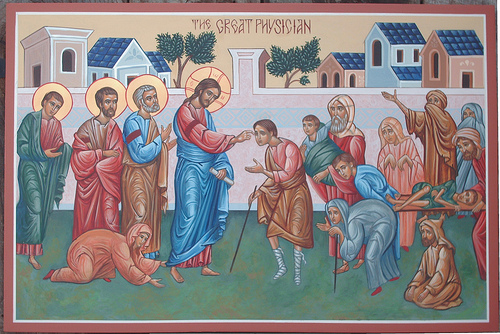
Icon of Christ the Divine Physician

The Healing Mission of Christ and the Church

A common title given to Jesus is Divine Physician because he heals humanity from sin and death. While our ultimate trust focus on God as healer of souls, He has employed various men and women over the centuries to stand as great witnesses to the truth. Such saints are called Doctors of the Church.

Not to be confused with medical doctors, Doctors of the Church are, “certain saints whose writing or preaching is outstanding for guiding the faithful in all periods of the Church’s history. To view a complete and detailed list of all saints with this honor please refer to Dr. Marcellino D’Ambrosio’s Doctors of the Catholic ChurchComplete List.

Working for God

Saints Work for the Divine Doctor

Because of the incredible need for healing and hope in this fallen world, today will mark the beginning of a weekly blog series Spiritual SurgeonsCo-workers with the Divine Physician. Every week we will focus on a different saint. We will examine key themes and advice from their writings to help us root out sin and grow in our relationship with God and neighbor. St. Catherine of Siena will be the focus of this inaugural Spiritual Surgeons installment.

Corruption of Sin

Catherine lived in the 14th century during a period of grave clergy corruption. She famously wrote to Pope Gregory XI urging him to return to Rome and clean up the abuses going on within the Catholic Church hierarchy. At that time, the papacy succumbed to the powers of the world (France) and the pope lived in Avignon to appease the French rulers. Catherine petitioned to the pope by declaring, “But, I hope, by the goodness of God that you will pay more heed to His honour and the safety of your own flock than to yourself, like a good shepherd, who ought to lay down his life for his sheep” (Letter to Gregory XI). Her brave and consistent witness to the Truth even against those in power brings us hope.

Cleansing fire

Furnace of Divine Love  

Along with Catherine’s teaching on the corruption of sin, she teaches sin decays the soul. Similar to how disease infects the body, so too, sin infects the soul. Physical surgery involves pain. Both in the actual procedure and the healing process afterwards. Spiritual surgery necessarily contains suffering as well. St. Catherine’s remedy includes the fire of God’s love.

Catherine warns against non-evasive spiritual treatments in fighting sin. According the Sienese saint in a letter to Pope Gregory XI, “If a wound when necessary is not cauterized or cut out with steel, but simply covered with ointment, not only does it fail to heal, but it infects everything, and many a time death follows from it.”  Her advice matches what Jesus taught on the Sermon of the Mount. In Matthew 5:29-30,

If your right eye causes you to sin, tear it out and throw it away.s It is better for you to lose one of your members than to have your whole body thrown into Gehenna. And if your right hand causes you to sin, cut it off and throw it away. It is better for you to lose one of your members than to have your whole body go to Gehenna.

Purification by Flames

Fire acts as a destructive or purifying agent. Catherine speaks of God’s love as a fire cleansing the soul from sin. The word fire occurs 94 times in The Dialogues of St. Catherine. Phrases such as fire of Divine love and fire of Divine charity occur 5 and 3 times respectively. Although the first man muddied himself with the disobedience of sin, Catherine reminds us that God became man to show us the path of salvation. She wrote in her Dialogues, 

So that each man has in his own person that very same key which the Word had, and if a man does not unlock in the light of faith, and with the hand of love the gate of heaven by means of this key, he never will enter there, in spite of its having been opened by the Word; for though I created you without yourselves, I will not save you without yourselves…My only-begotten Son, the Word, come and taken this key of obedience in His hands and purified it in the fire of divine love, having drawn it out of the mud, and cleansed it with His blood, and straightened it with the knife of justice, and hammered your iniquities into shape on the anvil of His own body.

Catherine of Siena

Catherine of Siena lived a profoundly holy life of faith. Her ability to correct clerical abuses with charity was second to none. According to St. Pope John Paul II in his Apostolic Letter Three Co-patronesses of Europe, “Catherine addressed churchmen of every rank, demanding of them the most exacting integrity in their personal lives and their pastoral ministry. The uninhibited, powerful and incisive tone in which she admonished priests, Bishops and Cardinals is quite striking.” Learning from this great Doctor of the Church not only deepened my knowledge about God but strengthened my personal relationship with God.

Related Links

Catherine of Siena—Pious Paladin for Today’s Current Clergy Corruption

Doctors of the Church— Definition and Complete List

Thank you for sharing!

Catholic Meme Monday— Issue 38

Hope you had a blessed Second Sunday in the Easter Season and Divine Mercy Sunday! 🙏 🌿 ❤️

Time for another Catholic Meme Monday.

Saint Mark pray for us!
Jesus I trust in You. ❤️❤️❤️
Not necessarily a meme but news I wanted to share with you all. 🙂🙂🙂
Font matters. 😆🤣😊
Absolutely love this diagram.
This is accurate. 🕊️🔥🙏
I feel convicted. **Proceeds to share Wordle boxes**
🤣😆🙂
Truth bomb 💥 by Chesterton.
Yes!!!
I post this as a reminder to myself. 🧼 🧺
Love the Easter Season!!!
Proclaim it loud and joyfully.

That’s all I have this week. Stay tuned for next week’s Catholic Meme Monday. Receive updates straight to your email inbox by subscribing to The Simple Catholic blog.

Thank you for sharing!

Catholic Meme Monday— Issue 37

Hope you had a blessed Easter Sunday! 🙏 🌿

Time for another Catholic Meme Monday.

A classic Easter morning meme.
😆🙂😊
Empty tomb real estate.
The first witnesses to the Resurrection. 😊😊😊
🍽️ 🥣 🧼 💦
Can you guess which one was most useless?
😊🙂😆
History via memes.
Last Supper humor from last week. 🙂
The local Catholic store is one of my weaknesses.
God can change things in a very short time.
🙏🙂❤️
He is pretty clear about the two Great Commandments.
Let’s end with a truth bomb by Mother Angelica. 🙂

That’s all I have this week. Stay tuned for next week’s Catholic Meme Monday. Receive updates straight to your email inbox by subscribing to The Simple Catholic blog.

Thank you for sharing!

Catholic Meme Monday— Issue 36

Hope you had a blessed Palm Sunday! 🙏😊

Let’s celebrate Holy Week with a King-sized 👑 Catholic Meme Monday.

Soon the holy images will be unveiled.
Palm Sunday humor!
Stay awake. Be ready! 😊😆🙂
More Palm Sunday funnies. 😆
An early Easter morning meme. 🙏🙂
The Word (Logos) always existed.
Let’s set the record straight! #realchurchhistory
Even more Palm 🌴 Sunday humor. 😊🙂
Pray for all the liturgical musicians in your parish this week. 🙏🙏🙏
😊😆🙂
WWJD
This is accurate. 💪 😆 ✌️ 🤝
#malchusear 🙂😆👂
Darn! 🙂😊

That’s all I have this week. Stay tuned for next week’s Catholic Meme Monday. Receive updates straight to your email inbox by subscribing to The Simple Catholic blog.

Thank you for sharing!

Palm Sunday Peace Treaty—Herod and Pilate

palm Sunday icon


Editor’s note: Article originally published on March 29, 2021.


Palm Sunday marks the beginning of the most sacred time in the Christian calendar Holy Week. As a cradle Catholic who attended Catholic schools my entire life, I have heard the extended gospel readings about Jesus’ triumphal entry into Jerusalem many times. On top of that I studied graduate level theology and read spiritual works for fun. I am not telling you this to boast, but rather to set forth my struggle when it comes to these important feast days: how can I learn something new when I have heard the same readings that I nearly have them committed to memory!

Same Old Story

we heard this story before


Sadly, I had this same mindset this morning before Mass. Remarkably, we arrived at the church with a few minutes to spar. After we found a pew, our three-year-old started asking about food (the #1 topic for toddlers!), specifically granola bars. To my dismay, I realized that I failed to stock the mass bag with snacks. I figured Palm Sunday 2019 would end up in a power struggle with a toddler and bitterness over not being able to pay attention to the liturgy. Miraculously, he did not dwell on the granola bars, and I was able to listen to all of the readings including the entirety of the LOTR length Gospel feature!

In between working to keep our children assuaged and paying attention to the Gospel, I noticed a peculiar line that I never heard before. Well, I probably heard that verse, but it probably never registered on my theological radar because I grew lukewarm in my faith. Making a mental note for me to check the passage later I continued to listen to the Gospel. Later in the day, I looked up Luke’s Gospel and found that peculiar verse—Luke 23:12. It reads “Herod and Pilate became friends that very day, even though had been enemies formerly.”

Enemy of My Enemy is My Friend

enemy off my enemy


The classic cliche “an enemy of my enemy is my friend” rings true for Herod and Pilate’s relationship in Palm Sunday’s Gospel. Both men were earthly rulers: a Jewish king and a Roman prefect. During the first century, the Roman Empire occupied the land of Judea.  Charges against Jesus in Luke 23:2 include “tax evasion” against the Romans and blasphemy as he claimed to be God.

According to Christian tradition, the historian Eusebius, ““Luke, who was by race an Antiochian and a physician by profession” (Eccl. Hist. 3.4). The meticulous nature of St. Luke’s prose especially in the prologue of his Gospel makes his passing reference at the sudden friendship of Herod and Pilate mysterious.

Lukewarm Leaders

apathy


Both Herod and Pilate presided over the trial of an innocent man. Both leaders gave in to external pressures to sentence an innocent victim to death. The former had John the Baptist beheaded at the behest of his vile wife, and of course Pilate caved into the pressures of the Jewish religious leaders to have Jesus Crucified. American author Leo Buscaglia declared; I have a very strong feeling that the opposite of love is not hate – it’s apathy. It’s not giving a damn.” Neither Herod nor Pilate “hated” John and Jesus. They balked at sentencing, but because of their weak wills, lukewarmness, and ultimate selfish desire to stay in power they caved to social pressures. Herod and Pilate’s actions showed an apathy over love of God.

pontius pilate

Will You Display Half-heartedness this Holy Week?

According to the Catechism of the Catholic Church paragraph 2094, “lukewarmness is hesitation or negligence in responding to divine love; it can imply refusal to give oneself over to the prompting of charity.” Wow! I did not realize the harshness associated with a lukewarm attitude. Possessing a spiritual “meh” attitude poses dangers of losing out on love. Will you aim to be holy the WHOLE holy week or merely haphazardly? The Holy Spirit prompted me to wake up when I heard Luke 23:12. Lent 2019 I have been mostly a Herod or a Pilate— apathetic toward true love seeking mostly control of my life. The good news is Holy Week is here. We can re-start our faith journey with a triumphal entry like Jesus. Let us ask for the gift of humility and the courage to avoid spiritual lukewarmness.

Related Links

Palm Sunday’s Gospel Drama

7 Palm Sunday traditions at Mass and their symbolism

Thank you for sharing!

How I Received Gratitude in the Face of the Most Stressful Week of the Year

Eucharistic Adoration energized me with gratitude.

Despite one of the busiest and most stressful weeks of the year at my job (we had a key member of our staff suddenly quit too) I was able to make the most of it.

Planning helped but shout out to my older kids for helping out.

Amelia had her First Reconciliation interview yesterday. She did great! Proud of her for practicing the Act of Contrition daily.I had her write out the prayer and practice before and after school. 🙂🙏

I published a review on the Piano Priest, finished my article for Saint Anthony Messenger, and started reading a book (to review) about Saint Maria Goretti.

All in all not too bad considering my store went through an entire grocery aisles reset.

Grateful for my wife and her encouragement and editing skills. Most thankful to have the opportunity to sit before our Lord during Eucharistic Adoration this week.

How was your week? How may I pray for you?

Thank you for sharing!

Music Review: The Piano Priest’s Debut Album (“Now and Not Yet”)


“To sing is to pray twice”

—Saint Augustine


Music has the ability to infuse the human heart, mind, and soul with energy and joy. Singing has helped me on my toughest days. There exists a certain universal quality to music that draws all mankind together.

Father Mark Baumgarten

The Catholic Church promotes unity (one of its four chief characteristics). Music is an important facet of the faith. While one might first think of liturgical music, God can use many kinds of music to promote unity and truth. Father Mark Baumgarten is a Catholic priest of the Archdiocese of Perth, Australia who uses his musical gifts to evangelize. I had the pleasure of talking with him about his debut album Now and Not Yet.

Fr. Mark wrote and performed the songs His music in the album ranges in style, due to his eclectic taste in music. The first half of the album is from his pre-seminary days and wrestle with philosophical questions about life, whereas the second half relates to his life as a priest.

The Australian priest showcases his skills as a musician, singer, and promoter of truth. Though his songs aren’t overtly Catholic in lyric, his music provides assurance about God’s Providence while being fun to listen to.

Father Mark Baumgarten at Mass
Listening to Now and Not Yet during the day helped ease my stress at work and got me nodding to his upbeat, jazzy tracks like Wake-Up Juice.
I highly recommend listening to this positive piano 🎹 infused album by Fr. Mark.
This music by visiting: Piano Priest.

P.S. Fr. Mark was a semi-finalist in the 2021 International Songwriting Competition (unsigned category) with the song “World Grow Up”

Thank you for sharing!